Deterministic Edge Inference and Multi-Modal Sensor Fusion: INT8 TensorRT Calibration, Extended Kalman Filter Tracking, and PCI-DSS v4.0 Tokenization
A systems engineering analysis of distributed edge computing architectures, examining hardware-accelerated RTSP video ingestion, INT8 Kullback-Leibler quantization, Extended Kalman Filter (EKF) sensor fusion, IEEE 802.1AS gPTP clock synchronization, and PCI-DSS v4.0 P2PE security.
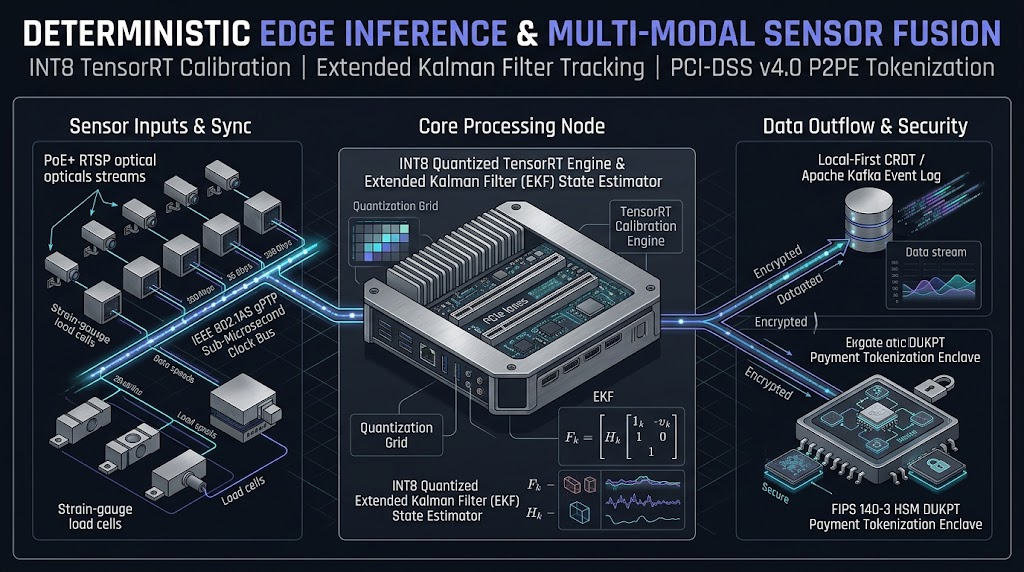
Deploying autonomous spatial telemetry, real-time inventory state estimation, and frictionless point-of-sale (POS) settlement across thousands of physical enterprise footprints requires a fundamental departure from centralized cloud-computing topologies. When physical commerce facilities operate on narrow 2% to 5% net operating margins, backhauling hundreds of high-bitrate Real-Time Streaming Protocol (RTSP) camera feeds per site to hyperscale cloud regions introduces prohibitive Wide-Area Network (WAN) egress costs, non-deterministic round-trip latency jitter exceeding 150 milliseconds, and single-point-of-failure ISP vulnerability. To achieve hard real-time determinism (<15 ms end-to-end inference and state-update latency), enterprise infrastructure architects deploy localized, ruggedized edge compute clusters executing INT8-quantized neural vision pipelines, Extended Kalman Filter (EKF) multi-modal sensor fusion, IEEE 802.1AS Precision Time Protocol (gPTP) hardware timestamping, and PCI-DSS v4.0 Point-to-Point Encryption (P2PE) hardware security modules.
1. Edge Ingestion Datapath: Zero-Copy RTSP Decoding & INT8 KL-Divergence Quantization
A single autonomous physical facility typically instruments between 120 and 300 overhead Power-over-Ethernet (PoE+) machine-vision cameras streaming H.265/HEVC video at 30 frames per second (FPS), paired with thousands of shelf-level strain-gauge load cells and sub-GHz electronic shelf labels (ESLs). Processing $300 \times 30 = 9,000\text{ frames per second}$ within a constrained 250-to-500-watt backroom thermal envelope requires strict hardware-accelerated zero-copy memory management.
Rather than decoding video frames on host x86/ARM CPU cores and copying raw RGB tensors across PCIe lanes via standard system RAM, production edge appliances utilize dedicated hardware NVDEC silicon engines mapped directly into unified GPU/NPU memory spaces (such as NVIDIA DeepStream / TensorRT or Linux DMA-BUF zero-copy pipelines). To maximize throughput per watt on edge tensor cores, FP32/FP16 convolutional and vision-transformer (ViT) weights are quantized into 8-bit integers (INT8) using post-training calibration that minimizes the Kullback-Leibler (KL) Divergence between the reference floating-point activation distribution ($P$) and the quantized INT8 distribution ($Q$):
$$q = \text{clamp}\left( \left\lfloor \frac{x}{s_{\text{scale}}} \right\rceil, \, -127, \, 127 \right) \quad \text{where } s_{\text{scale}} = \frac{\tau_{\text{opt}}}{127}$$
$$\tau_{\text{opt}} = \arg\min_{\tau} D_{\text{KL}}\left( P_{\text{FP32}} \,\parallel\, Q_{\text{INT8}}(\tau) \right) = \arg\min_{\tau} \sum_{i=1}^{N} P_{\text{FP32}}(i) \cdot \ln\left( \frac{P_{\text{FP32}}(i)}{Q_{\text{INT8}}(i; \tau)} \right)$$
By calibrating layer-wise activation clipping thresholds ($\tau_{\text{opt}}$) via KL-divergence minimization, edge inference engines achieve a $3.4\times\text{ to }3.8\times$ throughput acceleration and a $75\%$ reduction in memory-bandwidth pressure while holding Mean Average Precision ($\text{mAP}@50\text{:}95$) degradation below $0.3\%$ across dense multi-object tracking benchmarks.
2. Multi-Modal Sensor Fusion: Extended Kalman Filtering (EKF) & Bipartite Graph Matching
In high-density physical environments, single-modality sensing fails under adversarial real-world edge cases. Overhead optical cameras suffer from severe perspective occlusion, specular lighting reflections, and visual similarity across adjacent stock-keeping units (SKUs). Conversely, shelf-mounted Wheatstone-bridge strain-gauge load cells measure mass differentials ($\Delta m$) with sub-gram precision at $100\text{ Hz}$ sampling rates, but lack spatial resolution when multiple actors interact with adjacent shelves simultaneously.
To construct a deterministic state machine, edge clusters align optical video frames and load-cell ADC (Analog-to-Digital Converter) interrupts to a common sub-microsecond hardware clock using IEEE Std 802.1AS-2020 (Generalized Precision Time Protocol — gPTP). Time-aligned visual bounding-box trajectories and physical mass-displacement vectors are fused recursively via a discrete-time Extended Kalman Filter (EKF) paired with the Hungarian (Kuhn-Munkres) Bipartite Assignment Algorithm:
$$\hat{\mathbf{x}}_{k|k-1} = f\left(\hat{\mathbf{x}}_{k-1|k-1}, \, \mathbf{u}_{k-1}\right), \qquad \mathbf{P}_{k|k-1} = \mathbf{F}_{k} \mathbf{P}_{k-1|k-1} \mathbf{F}_{k}^{\top} + \mathbf{Q}_{k}$$ Where $\mathbf{F}_{k} = \left.\frac{\partial f}{\partial \mathbf{x}}\right|_{\hat{\mathbf{x}}_{k-1|k-1}}$ is the state-transition Jacobian and $\mathbf{Q}_k$ is the process noise covariance matrix.
$$\mathbf{S}_k = \mathbf{H}_k \mathbf{P}_{k|k-1} \mathbf{H}_k^{\top} + \mathbf{R}_k, \qquad \mathbf{K}_k = \mathbf{P}_{k|k-1} \mathbf{H}_k^{\top} \mathbf{S}_k^{-1}$$ $$d_M^2\left(\mathbf{z}_k, \, \hat{\mathbf{z}}_{k|k-1}\right) = \left(\mathbf{z}_k - h(\hat{\mathbf{x}}_{k|k-1})\right)^{\top} \mathbf{S}_k^{-1} \left(\mathbf{z}_k - h(\hat{\mathbf{x}}_{k|k-1})\right)$$
When a physical item interaction occurs at timestamp $t_k$, the sensor fusion engine constructs a cost matrix $\mathbf{C} \in \mathbb{R}^{M \times N}$ weighting the spatial 3D Mahalanobis distance ($d_M^2$) of tracked skeletal hand coordinates against the observed load-cell mass delta ($\Delta m_j$) and visual SKU classification logits. Solving the minimum-weight bipartite matching via the Kuhn-Munkres algorithm in $O(\max(M, N)^3)$ time binds the exact SKU identity to the anonymous session token without requiring optical barcode scanning.
3. Architectural Comparison: Cloud-Centric Batch vs. Hybrid Edge vs. Deterministic Autonomous Edge
Systems engineers and enterprise infrastructure architects evaluate physical telemetry deployments across five hardware, network, and cryptographic metrics:
| System Architecture Parameter | Cloud-Backhauled Video Processing | Hybrid Fog / Thin-Edge Gateway | Deterministic Autonomous Edge Cluster |
|---|---|---|---|
| End-to-End Inference & Fusion Latency | 250 ms – 800 ms (Subject to WAN TCP congestion & jitter) | 65 ms – 140 ms (Local frame filtering; cloud classification) | <12 ms deterministic (Local NVDEC + INT8 TensorRT + EKF) |
| WAN Uplink Bandwidth per Site | 600 Mbps – 1.8 Gbps continuous RTSP video egress | 80 Mbps – 200 Mbps (Cropped ROI keyframe uploads) | <3 Mbps (100% local video termination; compact Protobuf/Kafka logs) |
| Clock Synchronization Precision | NTP over WAN ($\pm 15\text{ to }50\text{ ms}$ skew; high fusion error) | Local NTP Server ($\pm 1\text{ to }5\text{ ms}$ skew across VLANs) | Hardware IEEE 802.1AS gPTP ($\le 500\text{ nanoseconds}$ phase accuracy) |
| ISP / WAN Outage Survivability | Zero (Total operational halt upon fiber cut or BGP flap) | Degraded (Queueing buffer overflow within 15–30 minutes) | 72+ Hours Full Autonomy (Local NVMe CRDT state + store-and-forward) |
| PCI-DSS v4.0 & Privacy Posture | High compliance surface (Raw video & session IDs transit WAN) | Moderate (Requires TLS inspection and cloud VPC isolation) | Ephemeral RAM-only vector processing + FIPS 140-3 P2PE DUKPT |
4. Local-First State Synchronization: Conflict-Free Replicated Data Types (CRDTs) & Event Streaming
Distributed edge clusters operating across thousands of regional branches must maintain eventual consistency with central enterprise Resource Planning (ERP) and supply-chain replenishment ledgers even during intermittent WAN partitions. Relying on synchronous two-phase commit (2PC) transactions across cellular or broadband links violates the CAP Theorem—sacrificing local store availability whenever network partitions occur.
To guarantee 100% local write availability alongside mathematically verifiable eventual consistency, modern edge inventory engines model SKU counts using state-based Positive-Negative Counter (PN-Counter) Conflict-Free Replicated Data Types (CRDTs) streamed over partitioned Apache Kafka log brokers:
- Monotonic Semilattice Merge Semantics: Each edge node $i \in \{1, \dots, n\}$ maintains a pair of vector registers: an increment vector $\mathbf{P}$ (restock and return events) and a decrement vector $\mathbf{N}$ (customer pick and shrinkage events). When WAN connectivity is restored following an outage, divergent state replicas merge deterministically via the commutative, associative, and idempotent join operator $\sqcup$: $\mathbf{P}_{\text{merged}}[i] = \max(\mathbf{P}_1[i], \mathbf{P}_2[i])$ and $\mathbf{N}_{\text{merged}}[i] = \max(\mathbf{N}_1[i], \mathbf{N}_2[i])$, yielding the exact global inventory state $S = \sum_i \mathbf{P}[i] - \sum_i \mathbf{N}[i]$ without lock contention or lost updates.
- Sub-GHz IEEE 802.15.4 Electronic Shelf Label (ESL) Actuation: Local inventory state transitions immediately trigger edge pricing controllers to broadcast delta-compressed display frames over ultra-low-power $2.4\text{ GHz}$ / sub-GHz time-slotted channel hopping (TSCH) mesh networks, updating thousands of bi-stable electrophoretic (e-ink) price tags with zero human intervention.
5. Cryptographic POS Isolation: PCI-DSS v4.0, P2PE, and ANSI X9.24-3 DUKPT Key Management
In frictionless checkout architectures, binding an anonymous spatial tracking session to a cryptographic payment credential at the entry turnstile or exit gate requires strict hardware isolation between the computer-vision inference plane and the Cardholder Data Environment (CDE). Under PCI-DSS Version 4.0 and the PCI Point-to-Point Encryption (P2PE) Standard, allowing unencrypted Primary Account Numbers (PANs) or EMV contactless track data to traverse the local Kubernetes edge cluster would bring every GPU server, camera VLAN, and switch port into full PCI audit scope.
To reduce the local store's CDE audit scope to zero, payment ingestion terminals utilize tamper-responsive FIPS 140-3 Level 3 Secure Reading and Exchange of Data (SRED) modules implementing Derived Unique Key Per Transaction (DUKPT) under ANSI X9.24-3 (using AES-128/AES-256). Upon EMV contactless tap or palm/biometric template hash matching, the terminal's internal cryptographic processor derives a one-time transaction key from its Initial Key (IK) and a 21-bit monotonically increasing Transaction Counter within the Key Serial Number (KSN). The encrypted ciphertext and an irreversible format-preserving surrogate token (PAN Token) are emitted over TLS 1.3 directly to the payment acquirer's cloud Hardware Security Module (HSM), while the local edge cluster receives only the non-sensitive session UUID—ensuring that neither biometric images nor cleartext payment credentials ever reside in edge DRAM or NVMe storage.
Primary Engineering, Cryptographic & Protocol References
- 1. Institute of Electrical and Electronics Engineers (IEEE): IEEE Std 802.1AS-2020 — Timing and Synchronization for Time-Sensitive Applications (Generalized Precision Time Protocol — gPTP).
- 2. Payment Card Industry Security Standards Council (PCI SSC): PCI Data Security Standard (PCI-DSS) v4.0 & Point-to-Point Encryption (P2PE) Cryptographic Architecture Requirements.
- 3. National Institute of Standards and Technology (NIST): FIPS PUB 140-3 — Security Requirements for Cryptographic Modules (Hardware Security Module Tamper & Key Zeroization Standards).
- 4. NVIDIA Developer Architecture Documentation: NVIDIA TensorRT Developer Guide — INT8 Symmetric Calibration and Kullback-Leibler (KL) Divergence Entropy Minimization.
- 5. Apache Software Foundation: Apache Kafka Distributed Event Streaming — Partitioned Log Compaction and Edge-to-Cloud MirrorMaker 2 Replication.
Related Enterprise Systems & Edge Infrastructure Research
- → Enterprise Edge AI vs. Hyperscale Cloud: Quantization Mechanics, Latency Physics, and On-Premises Neural Silicon
- → Linux eBPF Datapath Architecture: XDP vs tc (Traffic Control) Packet Processing Mechanics
- → Lossless Ethernet Fabrics for AI Clusters: RoCEv2 Congestion Control, PFC Deadlock Mitigation, ECN Marking, and Ultra Ethernet Transport (UET)
TrendSpike Editorial Team
Staff Research & Technical AnalysisIndependent research covering distributed cloud systems, modern enterprise software engineering, and macro-financial policy. Our technical and financial analyses reference primary documentation, official regulatory filings, and benchmark architectures.