The Transatlantic Deep-Tech Axis: Sovereign Cloud Infrastructure, Dual-Use Defense Procurement, and Cross-Border Venture Capital Capitalization
An institutional analysis of geographic technology specialization across the United States, Germany, and France, examining dual-use defense sovereignty, open-weight foundational models, EU Chips Act subsidies, and sovereign cloud capital expenditure models.
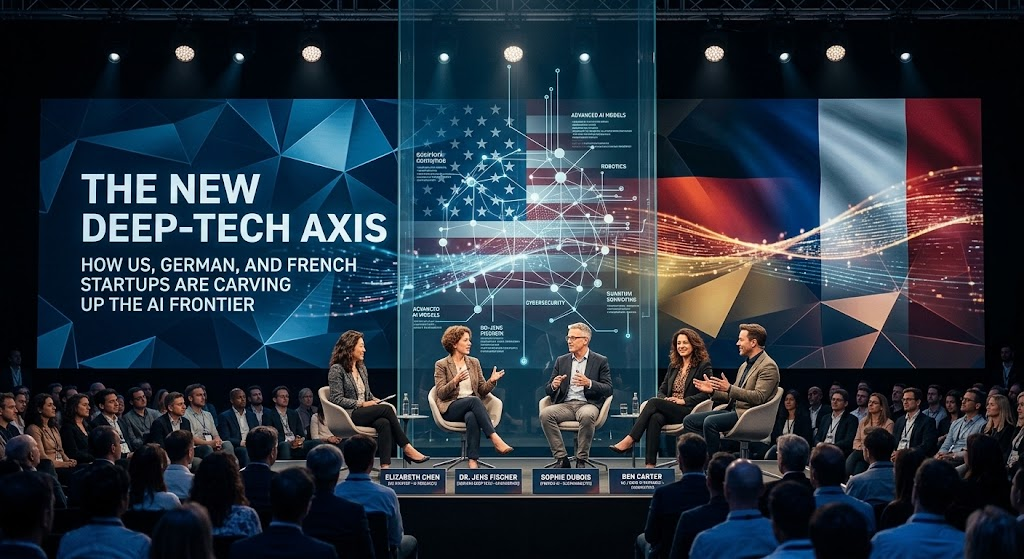
A profound geographic division of labor and capital allocation model is restructuring the global technology ecosystem. As private venture capital, institutional private equity, and sovereign state-backed funds concentrate into specialized deep-tech clusters across the United States, Germany, and France, the previous era of homogenous software globalization has fractured. While Silicon Valley venture pools accelerate theoretical superintelligence and physical robotic embodiment, European founders and sovereign authorities are anchoring capital into localized defense platforms, open-weight foundational models, and sovereign cloud infrastructure designed to mitigate reliance on extraterritorial technology monopolies.
1. The American Compute Hegemony: Foundational Scale & Embodied Physical Intelligence
In the United States, private venture capital and strategic corporate balance sheets remain singularly focused on massive capital expenditure (CapEx) scale, unprecedented compute clusters, and autonomous software execution. Rather than building incremental enterprise software applications, domestic American strategy concentrates capital behind high-conviction foundational architectures and physical robotics.
As analyzed in macroeconomic technology studies published by the National Science Foundation (NSF) Directorate for Technology, Innovation and Partnerships and the White House Office of Science and Technology Policy (OSTP), domestic U.S. deep-tech deployment is governed by two primary pillars:
- Unaligned Foundational Research: Ventures such as Safe Superintelligence (SSI) secure multi-billion-dollar private valuations with mandates explicitly stripped of commercial product cycles, enterprise software distractions, or near-term monetization pressures—focusing entirely on mathematical alignment and pre-training safety frameworks prior to scale deployment.
- Embodied Physical Intelligence & Silicon Alliances: Hardware-native robotics enterprises (such as Figure AI) deploy general-purpose humanoid robots directly onto industrial automotive assembly lines, backed by heavyweight silicon and cloud compute partnerships with Nvidia, Microsoft, and OpenAI.
The economic efficiency of this model relies on access to deep pools of taxable venture capital and ultra-scale GPU clusters financed by enterprise cash flows.
2. German Engineering Sovereignty: Defense Infrastructure, Industrial Automation, and Deep Research
Across the Atlantic, Germany’s startup and venture surge has anchored itself around defense sovereignty, industrial automation, and deep research spinouts from institutions such as the Max Planck Society and Fraunhofer-Gesellschaft. Munich-based Helsing has surged into Europe’s highest-valued defense technology powerhouse, raising historic mega-rounds to deploy real-time sensor processing, AI tactical decision support, and live targeting algorithms across NATO frontlines and airborne fleets.
In alignment with the European Defence Agency (EDA) Capability Development Plan and German federal Zeitenwende defense rearmament mandates, European deep-tech deployment integrates software directly into heavy precision engineering:
$$\text{Value Creation}_{\text{defense}} = \text{Public Procurement Commitment} \times \left( \frac{\text{Sensor Fusion Throughput}}{\text{Latency}_{\text{edge}}} \right) - \text{ITAR Compliance Friction}$$
$$\text{Efficiency Ratio} = \frac{\text{Perplexity Score}_{\text{open}}}{\text{Compute Footprint (FLOPs)} \cdot \text{Parameter Count}}$$
Alongside Helsing’s defense umbrella, research laboratories like Black Forest Labs establish open-weight image synthesis standards with the FLUX model family, while aerospace innovators like The Exploration Company construct modular reusable orbital capsules—blending Germany’s precision manufacturing legacy with software-driven autonomy.
3. Comparative Transatlantic Deep-Tech Ecosystems: United States vs. Germany vs. France
Institutional technology analysts and cross-border venture investors evaluate regional specialization across five core structural parameters:
| Ecosystem Parameter | United States (Silicon Valley / National) | Germany (Munich / Industrial Hubs) | France (Paris / European AI Core) |
|---|---|---|---|
| Primary Capital Deployment | Frontier foundation models & embodied physical robotics | Real-time defense software & precision hardware | Open-weight frontier LLMs & specialized clinical/industrial ML |
| Regulatory & Compliance Framework | Light federal oversight; state-level privacy mandates & CFIUS | NATO procurement standards & stringent export controls | EU Artificial Intelligence Act (AI Act) & GDPR compliance |
| Compute & Infrastructure Scale | Massive hyperscale clusters (100k+ NVIDIA H100/B200 nodes) | Decentralized edge compute & secured military cloud enclaves | European sovereign supercomputing grants & hybrid cloud partnerships |
| Commercial Monetization Model | Enterprise SaaS APIs, consumer subscriptions & defense primes | Long-cycle government defense contracts & B2B industrial supply chains | Enterprise custom deployments, sovereign cloud licenses & vertical SaaS |
| Sovereignty Posture | Global commercial dominance and technological hegemony | European strategic autonomy and frontline operational readiness | Break reliance on American cloud monopolies and open-source leadership |
4. France as the Epicenter of European Foundation AI & Sovereign Vertical ML
France has firmly established itself as the epicenter of European foundation artificial intelligence, spearheaded by Paris-based Mistral AI. Pushing open-weight frontier models that compete directly against legacy California labs, Mistral has become a cornerstone of European technological independence with multi-billion-dollar backing from domestic champions and international silicon giants.
Surrounding this foundation layer, a broader French ecosystem is operationalizing machine learning in specialized verticals, operating under the regulatory mandates of the European Union Artificial Intelligence Act (EU AI Act):
- Clinical Documentation Copilots: Ventures such as Nabla deploy specialized conversational AI agents directly into clinical workflows, automating electronic health record (EHR) documentation while complying with strict healthcare data residency rules.
- Real-Time Pathogen Detection: Hardware-software bio-tech enterprises like Spore.Bio build automated optical and machine-learning hardware to detect microbiological contamination in real time across food and pharmaceutical supply chains.
This structural divergence underscores that transatlantic technology centers no longer duplicate Silicon Valley playbooks; rather, they dominate specialized technological frontiers tailored to regional strategic needs.
Primary Policy & Technology References
- 1. **European Commission:** The European Union Artificial Intelligence Act (EU AI Act) — Compliance and Governance Framework.
- 2. **European Defence Agency (EDA):** Capability Development Plan — European Defense Technology & Real-Time Sensor Integration.
- 3. **National Science Foundation (NSF):** Directorate for Technology, Innovation and Partnerships — U.S. Deep-Tech Investment and Compute Strategies.
- 4. **White House Office of Science and Technology Policy (OSTP):** Federal Artificial Intelligence Research and Development Strategic Plan.
- 5. **Eurostat & OECD Directorate for Science, Technology and Innovation:** Cross-Border Venture Capital Concentration and Sovereign Deep-Tech Funding Statistics.
Related Global Technology & Policy Research
- → OECD Pillar Two 15% Global Minimum Tax: QDMTT, IIR, and UTPR Mechanics for Multinationals
- → Basel III Endgame (Basel 3.1): Risk-Weighted Assets (RWA), Output Floors, and Capital Adequacy Mechanics
- → Enterprise Edge AI vs. Hyperscale Cloud: Quantization Mechanics, Latency Physics, and On-Premises Neural Silicon
TrendSpike Editorial Team
Staff Research & Technical AnalysisIndependent research covering distributed cloud systems, modern enterprise software engineering, and macro-financial policy. Our technical and financial analyses reference primary documentation, official regulatory filings, and benchmark architectures.