Event-Driven Consistency Patterns: Transactional Outbox Pattern vs Change Data Capture (CDC)
An architectural engineering analysis of distributed systems reliability, comparing application-level transactional outbox tables with database transaction log-based Change Data Capture pipelines.
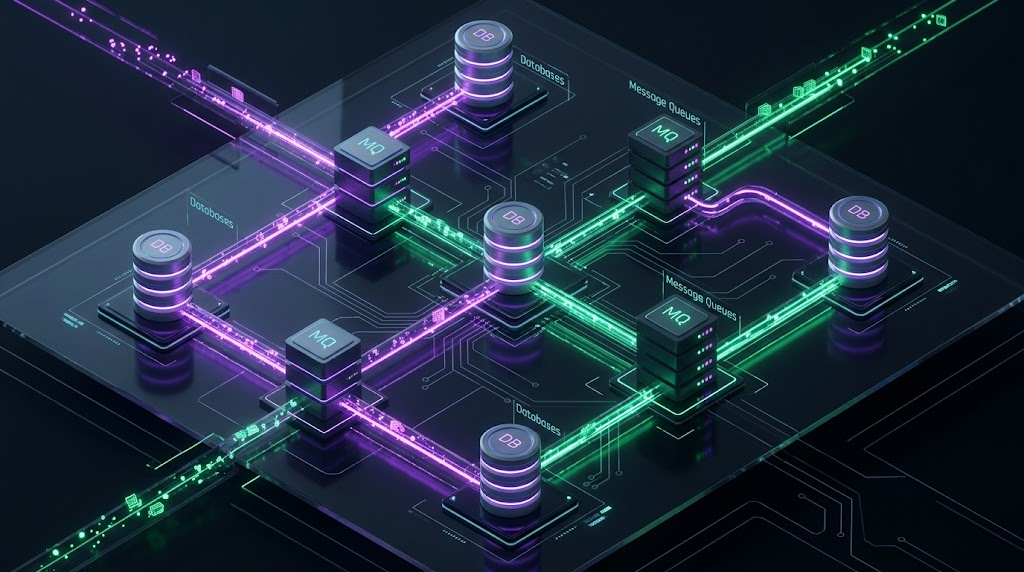
In distributed microservice architectures, maintaining transactional consistency across separate boundaries without distributed locking (such as 2-Phase Commit) represents a fundamental design challenge. When a service must update its primary relational database and concurrently broadcast a domain event to an asynchronous message broker (such as Apache Kafka or RabbitMQ), the dual-write problem emerges: if either operation fails, the system enters an inconsistent state. Resolving this reliably requires decoupled event emission through either the Transactional Outbox Pattern or log-based Change Data Capture (CDC).
1. The Dual-Write Problem in Microservice Workflows
Consider an enterprise order-processing microservice executing a business transaction:
- Write an updated order status to PostgreSQL.
- Publish an
OrderCompletedevent to an Apache Kafka cluster.
If the service crashes after committing the database transaction but before the network acknowledges the Kafka message, downstream billing and shipping services never receive the event. Conversely, if the message publishes first and the database transaction aborts due to a constraint violation, external consumers act on non-existent state. Because atomic multi-system writes across HTTP/TCP connections violate network reliability guarantees, decoupling transaction persistence from transport publishing is non-negotiable.
2. The Transactional Outbox Pattern
The Transactional Outbox pattern guarantees at-least-once message delivery by restricting the application's immediate write strictly to the local database ACID boundary:
- The Outbox Table: Alongside domain entity mutations, the application writes the event payload directly into a dedicated
outboxtable within the same database transaction. - ACID Guarantees: Either both the business data update and the outbox event record commit together, or both rollback completely on failure.
- Message Relay Process: An independent poller or event publisher reads unread records from the outbox table, publishes them to the message broker, and marks them as processed or deletes them upon confirmed receipt.
While conceptually straightforward to implement, polling models introduce database overhead: high-frequency SQL queries on indexed tables introduce contention, and poll intervals add slight message delivery latency.
3. Log-Based Change Data Capture (CDC)
Log-based Change Data Capture eliminates polling latency and database read amplification by streaming mutations directly from the database's low-level write-ahead log (WAL in PostgreSQL, binlog in MySQL):
- Zero Application Polling Overhead: Platforms such as Debezium attach to database replication slots natively, monitoring transaction commit records as byte streams without issuing active SQL queries.
- Sub-Millisecond Event Dispatch: Because mutations are captured directly off the sequential disk log as commits occur, latency from database commit to broker topic drops into single-digit milliseconds.
- Combined Outbox CDC Pattern: Modern enterprise stacks combine both architectures: the application writes to an outbox table, and Debezium captures mutations from that table's log without impacting application throughput.
4. Operational Trade-Off Matrix for Production Environments
Selecting the optimal pattern requires evaluating operational complexity against throughput demands:
- Infrastructure Footprint: Outbox polling requires zero new infrastructure and operates cleanly within existing application frameworks. CDC introduces dedicated infrastructure layers—including Kafka Connect workers, schema registries, and replication slot monitoring.
- Database Load Under Peak Scale: At 50,000 operations per second, database outbox table polling causes heavy read/write contention and table bloat. CDC reads sequential log files sequentially from disk, isolating the core query engine from event extraction pressure.
- Failure Domain Isolation: If a Kafka broker becomes unavailable, an outbox table absorbs event backlogs safely within the primary storage engine. In pure CDC deployments, stalled brokers can cause replication slots to retain uncheckpointed WAL files, risking disk exhaustion on primary database clusters if not alerted properly.
TrendSpike Editorial Team
Staff Research & Technical AnalysisIndependent research covering distributed cloud systems, modern enterprise software engineering, and macro-financial policy. Our technical and financial analyses reference primary documentation, official regulatory filings, and benchmark architectures.