Hackers Steal Flock Safety Camera Data: Teardown Exposes Software Tracking People and Cars
A hacker group physically dismantled a Flock Safety camera, cracked its stored encryption key, and revealed software that explicitly logs pedestrians alongside millions of vehicle images.
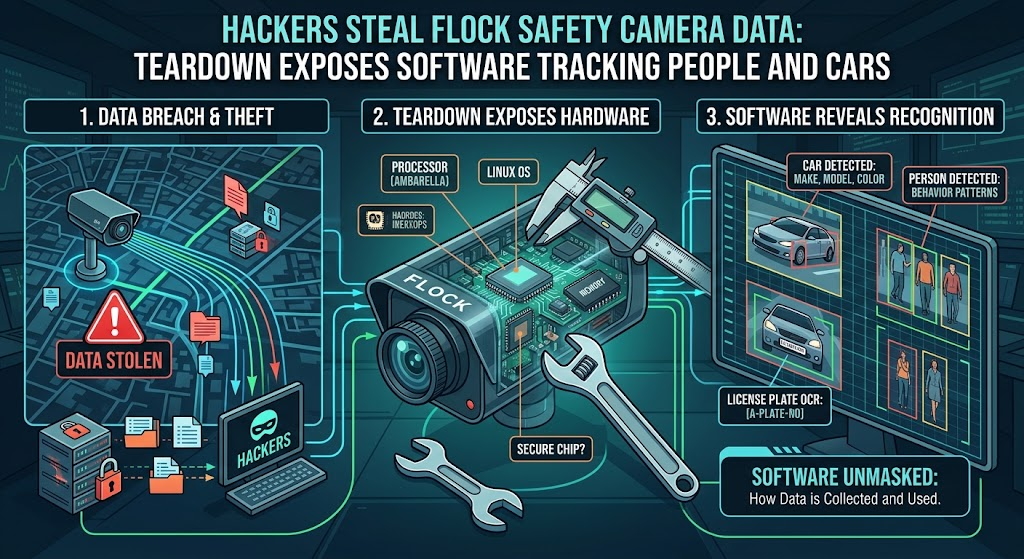
Search interest for "Flock cameras" surged by more than 700% after an explosive joint investigation by 404 Media and WIRED revealed that a hacker group physically dismantled a roadside Flock Safety surveillance camera, cracked its internal storage, and extracted its proprietary software. The breach offers an unprecedented look into how the nationwide automated license plate reader (ALPR) network tracks not only vehicles, but pedestrians and cyclists as well.
Cracking On-Device Encryption
According to reports, a hacker collective calling itself stegan0gram removed a Flock camera installation from an active roadway and performed complete hardware and software reverse-engineering. While Flock Safety has previously characterized its camera hardware as safeguarded by on-device encryption, the group discovered unencrypted partitions within the camera’s Android-based operating system.
Critically, one unencrypted media partition contained the cryptographic keys required to unlock stored captures. That flaw enabled the group to access three weeks of archived operation logs, decrypting footage that spanned over 50,000 passing vehicles and roughly 1.6 million on-device images.
Beyond License Plates: Explicitly Detecting People
While public discussions surrounding Flock cameras typically focus on vehicle registration plates, analysis of the extracted code exposed much wider computer-vision capabilities running directly at the network edge:
- Pedestrian and Cyclist Classification: The internal software features automated object-detection algorithms that explicitly isolate people and bicycles, logging their exact image coordinates alongside a numerical confidence score.
- Visual Detail and Bumper Extraction: The camera’s visual parser regularly isolated individual bumper stickers, decals, and accessories—including an American flag patch on a passing motorcyclist’s saddlebag.
- Edge Detection vs. Server Processing: The on-device hardware acts as a high-speed motion capture engine running roughly 20 custom applications, while deeper optical character recognition (OCR) and database cross-referencing take place on central cloud servers.
- Widespread Law Enforcement Sharing: Decrypted architecture files highlighted how regional data feeds directly into national investigative networks accessible across thousands of law enforcement and corporate partner agencies.
Surveillance Scale Metric:
During a single 21-day log window extracted from just one unit, the roadside camera captured roughly 3,300 vehicles daily, generating over 1.6 million image frames before rotating out older storage.
Backlash and Security Implications
In response to the incident, Flock Safety reiterated that the physical removal and unauthorized tampering with roadside infrastructure is illegal and maintained that it takes device security seriously. However, cybersecurity analysts note that leaving local cryptographic keys accessible on physical hardware mounted in public spaces creates substantial vulnerability risks for public surveillance infrastructure.
As civil liberties groups intensify scrutiny over nationwide camera networks and vehicle tracking databases, the hardware leak is likely to accelerate calls for stricter federal oversight and municipal privacy audits across the country.
Related Reading: Learn how enterprises safeguard cloud-connected infrastructure from widespread failures in our coverage of enterprise system downtime and platform stability, or discover how IT administrators counter cyber vulnerabilities in our breakdown of critical enterprise security updates and exploit prevention.
TrendSpike Editorial Team
Staff Research & Technical AnalysisIndependent research covering distributed cloud systems, modern enterprise software engineering, and macro-financial policy. Our technical and financial analyses reference primary documentation, official regulatory filings, and benchmark architectures.