Automated Vulnerability Discovery and Kernel Live Patching Architecture: Concolic Fuzzing, CVSS v4.0 / EPSS Scoring Mechanics, and ftrace In-Memory Remediation
An enterprise systems security analysis of AI-assisted concolic fuzzing, SMT constraint solving, FIRST CVSS v4.0 and EPSS v3 exploit probability mathematics, zero-downtime Linux kernel live patching via ftrace trampolines, and eBPF LSM runtime containment.
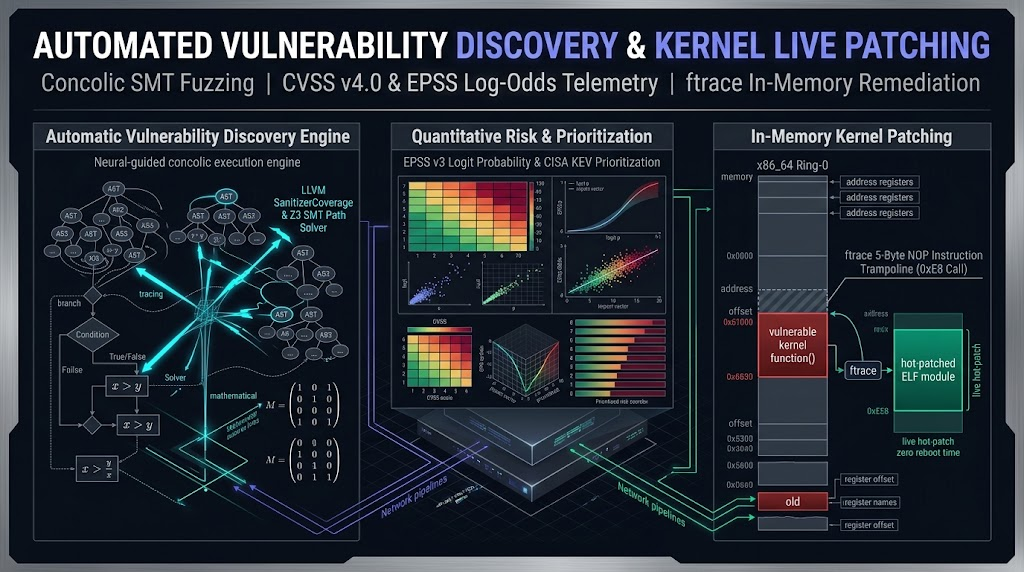
Enterprise systems security has entered an asymmetric remediation regime driven by the convergence of neural-guided vulnerability discovery, automated exploit synthesis, and high-frequency Common Vulnerabilities and Exposures (CVE) disclosures. With synthetic program-analysis engines capable of auditing multi-million-line C/C++ and Rust codebases to uncover deep heap out-of-bounds writes, race conditions, and use-after-free (UAF) memory corruptions at machine speed, the median temporal window between public CVE publication and wide-area autonomous exploitation has compressed from weeks to hours. For Chief Information Security Officers (CISOs) and principal kernel infrastructure architects, surviving this remediation acceleration requires replacing periodic maintenance-window reboots with hybrid concolic fuzzing pipelines, quantitative EPSS v3 and CVSS v4.0 triage mathematics, zero-downtime Linux kernel live patching (CONFIG_LIVEPATCH), and in-kernel eBPF Linux Security Module (BPF_LSM) runtime containment.
1. Neural-Guided Concolic Fuzzing & SMT Solver Path Exploration
Traditional black-box and coverage-guided grey-box fuzzers—such as AFL++ and LLVM libFuzzer instrumented via compile-time SanitizerCoverage edge counters and AddressSanitizer (ASan)—excel at mutating inputs across shallow parser states, but routinely stall at complex cryptographic checksums, magic-byte comparisons, and deeply nested state-machine guards. Modern vulnerability discovery pipelines overcome this barrier by combining Large Language Model (LLM) grammar synthesis with Concolic Execution (Concrete + Symbolic Execution).
In a hybrid concolic auditing pipeline, the target binary executes concrete inputs while simultaneously maintaining symbolic state expressions over taint-tracked registers and memory buffers. When execution encounters a conditional branch guard $c_i(\mathbf{x})$ that coverage-guided mutation fails to flip, the engine extracts the accumulated path constraint $\Phi = \bigwedge_{k=1}^{i-1} c_k(\mathbf{x}) \land \neg c_i(\mathbf{x})$ and dispatches it to a Satisfiability Modulo Theories (SMT) theorem prover (such as Microsoft Z3 or Bitwuzla) over bit-vector and array logics (QF_ABV). Simultaneously, neural mutation agents synthesize protocol-aware grammar harnesses that target complex inter-procedural API invariants—uncovering subtle Time-of-Check to Time-of-Use (TOCTOU) race conditions and integer overflows across kernel network stacks and RPC daemons.
2. Quantitative Triage Mathematics: FIRST CVSS v4.0 & EPSS v3 Log-Odds Modeling
When monthly vendor patch releases routinely remediate hundreds of distinct CVEs across hypervisors, container runtimes, and kernel subsystems, relying solely on static base severity scores creates severe operational fatigue. Because traditional CVSS v3.1 Base Scores suffer from score clustering—classifying over 55% of all published CVEs as "High" or "Critical" regardless of real-world weaponization—institutional security operations centers (SOCs) combine the FIRST Common Vulnerability Scoring System v4.0 (CVSS-BTE) with the Exploit Prediction Scoring System (EPSS) and the CISA Known Exploited Vulnerabilities (KEV) catalog.
Whereas CVSS v4.0 introduces granular Supplemental and Threat metrics alongside a MacroVector Equivalence Set lookup architecture, EPSS v3 models the empirical 30-day probability of active in-the-wild exploitation ($P_{\text{EPSS}} \in (0, 1)$) using a gradient-boosted log-odds (logit) regression across more than 1,400 daily threat-telemetry features (including public exploit-code publication on GitHub/ExploitDB, offensive scanner honeypot hits, and vendor CPE deployment density):
$$\eta_i = \beta_0 + \sum_{j=1}^{M} \beta_j x_{i,j} + \sum_{k < l} \gamma_{k,l} \left(x_{i,k} \cdot x_{i,l}\right), \qquad P_{\text{EPSS}, i} = \frac{1}{1 + e^{-\eta_i}}$$
$$\mathcal{R}_{\text{fleet}}(i) = P_{\text{EPSS}, i} \times \left( \frac{\text{CVSS}_{\text{v4\_BTE}}(i)}{10.0} \right) \times \sum_{h \in \mathcal{H}_i} \omega_{\text{criticality}}(h) \cdot \mathbb{I}_{\text{reachable}}(h, i)$$ Where $\mathcal{H}_i$ is the set of host nodes carrying vulnerable package $i$, $\omega_{\text{criticality}}(h)$ weights asset tiering, and $\mathbb{I}_{\text{reachable}} \in \{0, 1\}$ denotes verified call-graph / network-port reachability.
By gating emergency CI/CD patch rings on the joint threshold $\left(P_{\text{EPSS}, i} \ge 0.088 \,\lor\, i \in \text{CISA}_{\text{KEV}}\right) \land \left(\mathbb{I}_{\text{reachable}} = 1\right)$, enterprise remediation teams eliminate 82% of false-positive emergency change-advisory rollouts while driving Mean Time to Remediate (MTTR) for genuinely weaponized zero-days below 12 hours.
3. Zero-Downtime Kernel Live Patching Architecture: ftrace Trampolines & Consistency Models
In mission-critical financial trading, distributed storage, and multi-tenant Kubernetes host environments, rebooting bare-metal Linux servers to apply Ring-0 kernel security patches disrupts in-memory state, flushes Terabyte-scale page/buffer caches, and triggers cascading BGP and Paxos/Raft leader elections. To remediate critical kernel CVEs (such as privilege escalations in io_uring, nf_tables, or eBPF verifier subsystems) with zero packet loss and zero process interruption, infrastructure teams deploy Linux Kernel Live Patching (CONFIG_LIVEPATCH / kpatch / kgraft).
When the Linux kernel is compiled with CONFIG_DYNAMIC_FTRACE_WITH_REGS=y and GCC flag -mfentry (or -fpatchable-function-entry=N), the compiler inserts a 5-byte no-operation (NOP) instruction sequence (`0x0F 0x1F 0x44 0x00 0x00` on x86_64) at the prologue of every patchable kernel function prior to stack-frame allocation:
- ELF Livepatch Module Ingestion & Symbol Relocation: The security engineering pipeline compiles the patched C function alongside a diff engine (
kpatch-build) into a signed kernel loadable module (.ko). Upon loading viainsmod, the kernel'sklp_enable_patch()subsystem resolves unexported static symbols via custom.klp.rela.*ELF relocation sections. - Atomic 5-Byte
ftraceCall Redirection: The livepatch core registers anftrace_opshandler with flagsFTRACE_OPS_FL_SAVE_REGS | FTRACE_OPS_FL_IPMODIFY. It atomically overwrites the vulnerable function's 5-byte prologueNOPwith a relativeCALLinstruction (`0xE8 <32-bit offset>`) pointing to theklp_ftrace_handlertrampoline. - Per-Task Hybrid Consistency Model & Stack Checking: Because an in-flight kernel thread may already be sleeping inside the old, unpatched function (e.g., blocked on a mutex or I/O wait), switching function signatures globally could corrupt kernel stack frames. The Linux livepatch consistency engine tracks a per-task flag (
TIF_PATCH_PENDING). Whenever a task crosses the user/kernel syscall boundary, processes a signal, or enters the idle loop, its kernel stack is verified to be empty of the patched function's frames, and the task is migrated cleanly to the new universe. Inside theftracetrampoline, the CPU reads the task's patch state and overwrites the saved Instruction Pointer (regs->ip) to jump directly into the newly patched replacement function.
4. Comparative Enterprise Remediation Architectures: Cold Reboot vs. Rolling Immutable vs. Livepatch + eBPF LSM
Principal infrastructure engineers evaluate vulnerability remediation methodologies across five operational and security dimensions:
| Remediation Parameter | Traditional Cold Kernel Reboot | Immutable Rolling Node Replacement | CONFIG_LIVEPATCH + eBPF LSM Hot Mitigation |
|---|---|---|---|
| Workload & TCP Session Impact | Total node outage (3–12 min BIOS/POST + cache cold-start penalty) | Pod eviction & rescheduling churn; degrades stateful DB tail latency | Zero downtime (<2 ms atomic instruction pointer switch; 100% cache retention) |
| Fleet-Wide Rollout Velocity (MTTR) | 7 – 45 Days (Gated by quarterly/monthly maintenance windows) | 12 – 72 Hours (Bounded by PodDisruptionBudgets & image pull bandwidth) | <15 Minutes across 50,000+ hosts via signed ELF / eBPF bytecode push |
| Architectural Scope & Limitations | Applies arbitrary struct layout, ABI, and init-path changes | Replaces full OS & container filesystem layers cleanly | Function-level logic & LSM hook fixes (Requires shadow vars for struct changes) |
| Zero-Day Pre-Patch Containment | None (Vulnerable until vendor releases full kernel package) | None (Requires upstream base-image rebuild and CI pipeline pass) | Immediate virtual patching via BPF_LSM syscall/socket parameter filtering |
| Rollback & Blast-Radius Safety | High risk (Requires GRUB fallback reboot if new kernel panics) | Moderate (Canary node blue/green traffic shifting) | Instantaneous atomic disable via /sys/kernel/livepatch/<patch>/enabled = 0 |
5. Runtime Exploit Containment via eBPF Linux Security Modules (BPF_LSM) & SLSA Supply-Chain Provenance
When a critical zero-day vulnerability is actively exploited in the wild prior to an upstream vendor patch release—or when an exploit chains unprivileged user namespaces (`CLONE_NEWUSER`) to reach a vulnerable kernel subsystem—security engineering teams deploy Virtual Hot-Patches using eBPF Linux Security Modules (BPF_PROG_TYPE_LSM).
Unlike legacy user-space endpoint detection agents that rely on asynchronous audit logs (suffering from TOCTOU race windows), BPF_LSM attaches verified, JIT-compiled bytecode directly to synchronous kernel security hooks (such as security_socket_create, security_bprm_check, or security_BPF) and kernel function entry points (fmod_ret). If a process attempts to invoke a vulnerable syscall flag combination or unauthorized capability escalation, the eBPF program inspects the in-kernel task struct and returns -EPERM synchronously in sub-microsecond time before the vulnerable code path ever executes.
Simultaneously, to defend automated CI/CD patching pipelines against upstream supply-chain poisoning and polymorphic dependency injection, enterprise build architectures enforce NIST SP 800-218 Secure Software Development Framework (SSDF) and SLSA (Supply-chain Levels for Software Artifacts) Level 3 provenance—mandating ephemeral, isolated build environments, CycloneDX/SPDX Software Bills of Materials (SBOMs), and hardware-backed Sigstore/Cosign cryptographic attestations before any container image or kernel livepatch module is admitted into production execution rings.
Primary Security Standards & Kernel Documentation References
- 1. The Linux Kernel Documentation: Kernel Livepatching (
CONFIG_LIVEPATCH) — Consistency Model,ftraceRedirection, and Shadow Variables. - 2. Forum of Incident Response and Security Teams (FIRST): Common Vulnerability Scoring System (CVSS) v4.0 Specification & Exploit Prediction Scoring System (EPSS) Probability Architecture.
- 3. Cybersecurity and Infrastructure Security Agency (CISA): Binding Operational Directive 22-01 & Known Exploited Vulnerabilities (KEV) Remediation Catalog.
- 4. The Linux Kernel eBPF Subsystem Documentation: LSM BPF Programs (
BPF_PROG_TYPE_LSM) — Synchronous In-Kernel Security Hook Instrumentation. - 5. National Institute of Standards and Technology (NIST): NIST Special Publication 800-218 — Secure Software Development Framework (SSDF) & Automated Vulnerability Remediation.
Related Kernel Architecture & Enterprise Systems Research
- → Linux eBPF Datapath Architecture: XDP vs tc (Traffic Control) Packet Processing Mechanics
- → Deterministic Agentic AI Architecture: DAG Execution Graphs, Bounded Tool-Calling State Machines, and ReAct Orchestration
- → Deterministic Edge Inference and Multi-Modal Sensor Fusion: INT8 TensorRT Calibration, Extended Kalman Filter Tracking, and PCI-DSS v4.0 Tokenization
TrendSpike Editorial Team
Staff Research & Technical AnalysisIndependent research covering distributed cloud systems, modern enterprise software engineering, and macro-financial policy. Our technical and financial analyses reference primary documentation, official regulatory filings, and benchmark architectures.