Confidential Computing and Hardware Memory Encryption Architecture: AMD SEV-SNP, Intel TDX, and AES-128-XTS DRAM Bus Cryptography
An institutional hardware security and microprocessor architecture analysis of Confidential Computing enclaves, examining inline AES-128-XTS DRAM bus encryption engines, AMD SEV-SNP Reverse Map Tables (RMP), and Intel Trust Domain Extensions (TDX).
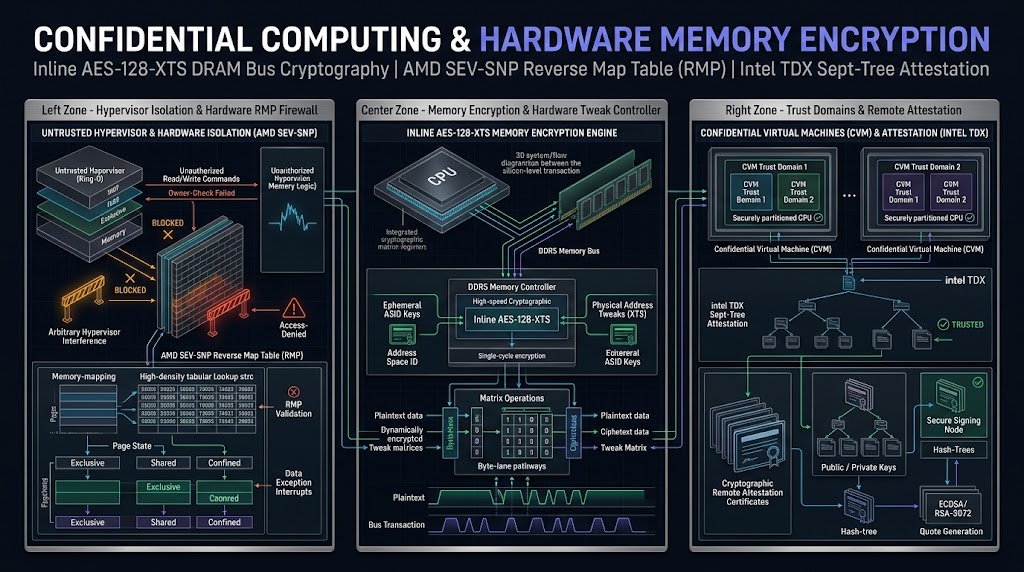
In multi-tenant cloud infrastructure, traditional virtualization security models rely on the implicit assumption that the host hypervisor (Ring -1 / KVM / Xen) and data-center physical administrators are inherently trustworthy. However, privileged hypervisor compromises, cold-boot DRAM extraction, and passive interposer probing across DDR5 dual in-line memory module (DIMM) buses expose plaintext guest memory directly to host-level adversaries. Confidential Computing eliminates the hypervisor from the Trusted Computing Base (TCB) by embedding inline, hardware-enforced cryptographic engines directly inside the CPU die's integrated memory controller (IMC). Through architectures such as AMD Secure Encrypted Virtualization-Secure Nested Paging (SEV-SNP) and Intel Trust Domain Extensions (TDX), every cache line evicted to external DRAM is encrypted with ephemeral, per-VM silicon keys and protected against ciphertext replay, memory aliasing, and page-table remapping attacks.
1. Inline Memory Controller Cryptography: AES-128-XTS & Physical Address Tweaking
Encrypting multi-terabyte server DRAM footprints at DDR5-6400 memory bus speeds requires a cryptographic primitive capable of random 64-byte cache-line access without cipher-block chaining dependencies or expansion tags that alter standard DIMM capacity. Both AMD EPYC and Intel Xeon Scalable processors implement inline AES-128-XTS (XOR-Encrypt-XOR-based Tweaked-Codebook Mode with Ciphertext Stealing) engines directly inside the silicon path between the Last-Level Cache (LLC) and the physical DDR5 PHY channels.
To prevent identical 64-byte plaintext blocks located at different physical memory addresses from producing identical ciphertexts (which would leak structural memory patterns to an attacker observing the memory bus), the inline encryption engine incorporates the System Physical Address ($\text{SPA}$) as a cryptographic tweak input alongside an ephemeral 128-bit encryption key managed exclusively by an on-die security coprocessor and indexed by the guest virtual machine's Address Space Identifier ($\text{ASID}$) or KeyID.
$$C_j = E_{K_1}^{\text{AES}}\!\left( P_j \oplus \left( E_{K_2}^{\text{AES}}(\text{SPA}_{\text{line}}) \otimes \alpha^j \right) \right) \oplus \left( E_{K_2}^{\text{AES}}(\text{SPA}_{\text{line}}) \otimes \alpha^j \right)$$ Where $P_j$ is the $j$-th 128-bit plaintext block within a 64-byte cache line ($j \in \{0,1,2,3\}$), $K_1$ is the per-VM ephemeral data encryption key, $K_2$ is the tweak key, and $\otimes \alpha^j$ denotes polynomial multiplication in the Galois Field $\text{GF}(2^{128})$.
$$\text{SPA}_{\text{tagged}} = \underbrace{\text{KeyID / C-Bit}}_{\text{Bits } [51 : 52-k]} \;\Vert\; \underbrace{\text{Physical Page Frame Number (PFN)}}_{\text{Bits } [51-k : 12]} \;\Vert\; \underbrace{\text{Page Offset}}_{\text{Bits } [11 : 0]}$$ Where upper physical address bits route cache lines through the corresponding KeyID cryptographic pipeline inside the memory controller without software intervention.
2. Mitigating Hypervisor Page-Table Remapping: AMD SEV-SNP Reverse Map Table (RMP)
First-generation memory encryption (such as original AMD SEV and SEV-ES) protected memory confidentiality against passive physical probing, but lacked cryptographic integrity protection against an active, malicious hypervisor. Because the host hypervisor manages the second-level Nested Page Tables (NPT / EPT) that translate Guest Physical Addresses ($\text{GPA}$) into System Physical Addresses ($\text{SPA}$), a compromised hypervisor could remap two different $\text{GPA}$ pointers to the same underlying $\text{SPA}$ (an aliasing attack) or replay old ciphertext pages to corrupt guest control flow.
AMD SEV-SNP (Secure Nested Paging) closes this attack surface by introducing a hardware-enforced Reverse Map Table (RMP) stored in reserved system DRAM. Indexed by every $4\text{ KB}$ block of System Physical Address space, the RMP maintains a strict $1:1$ inverse mapping ($\text{SPA} \mapsto \{\text{Owner ASID}, \, \text{Target GPA}, \, \text{Validated Bit}, \, \text{Page Permissions}\}$):
- Hardware TLB Walk Verification: At the end of every nested page table walk, the CPU's Memory Management Unit (MMU) queries the RMP entry for the resolved $\text{SPA}$. If the RMP entry's recorded $\text{ASID}$ and $\text{GPA}$ do not exactly match the guest VM performing the memory access, the CPU aborts the instruction and raises a synchronous
#PF (RMP Violation)fault. - Guest-Executed `PVALIDATE` Instruction: Before a Confidential VM uses any newly allocated memory page, the guest kernel must explicitly execute the privileged
PVALIDATEinstruction to set the RMP entry'sValidatedbit. If a malicious hypervisor attempts to unmap and swap the page without guest consent, the validation bit clears, triggering a#VC (VMM Communication Exception)inside the guest.
3. Architectural Comparison: AMD SEV-SNP vs. Intel TDX vs. ARM CCA
Cloud infrastructure security architects evaluate silicon confidential computing implementations across five hardware isolation and attestation dimensions:
| Architectural Feature | AMD EPYC SEV-SNP | Intel Xeon TDX (Trust Domains) | ARMv9 CCA (Realms) |
|---|---|---|---|
| Root-of-Trust Anchor | Dedicated on-die ARM Cortex-A5 Secure Processor (ASP) | CPU-hosted Secure Arbitration Mode (`SEAM` Module) | Realm Management Monitor (`RMM`) at `EL2` |
| Memory Encryption Engine | AES-128-XTS per-ASID Key + C-Bit (Bit 51) | MKTME AES-128/256-XTS + 28-bit ECC MAC | Memory Protection Engine (MPE) AES-XTS |
| Page Integrity Structure | Reverse Map Table (RMP) in system DRAM | Secure Extended Page Tables (S-EPT) + PAMT | Granule Protection Table (GPT) in Root World |
| Cryptographic MAC Overhead | Zero DRAM capacity loss (RMP architectural enforcement) | Inline 28-bit cryptographic MAC stored in ECC bits | Implementation-defined MPE tag storage |
| Device I/O Passthrough | SEV-TIO (Trusted I/O via PCIe TDISP/IDE) | TDX Connect (PCIe IDE + TDISP) | Device Assignment (RME-DA) over PCIe IDE |
4. Intel TDX Architecture: Secure Arbitration Mode (SEAM) & Cryptographic ECC MACs
Whereas AMD offloads key management and attestation to an independent on-die Secure Processor, Intel Trust Domain Extensions (TDX) introduces a new CPU privilege mode called Secure Arbitration Mode (SEAM), which hosts a digitally signed, CPU-attested micro-hypervisor module (`Intel TDX Module`) residing in hardware-isolated range registers (`SEAMRR`).
To enforce cryptographic memory integrity alongside confidentiality, Intel's Multi-Key Total Memory Encryption (MKTME) engine repurposes unused bits within standard server DDR5 Error-Correcting Code (ECC) metadata to embed a 28-bit SHA-3 / cryptographic Message Authentication Code (MAC) on every 64-byte cache line. If an attacker or compromised host hypervisor modifies a single bit of ciphertext in physical DRAM or attempts to transplant a ciphertext cache line from another address, the memory controller's inline MAC verification fails upon cache-line fill, poisoning the cache line and raising an unrecoverable hardware fault before corrupted data reaches the CPU execution pipeline.
Primary Silicon Security Specifications & Architecture References
- 1. Advanced Micro Devices (AMD) White Paper: AMD SEV-SNP: Strengthening VM Isolation with Integrity Protection and Reverse Map Tables (RMP).
- 2. Intel Corporation Architectural Specification: Intel® Trust Domain Extensions (Intel® TDX) Module Base Architecture & MKTME Cryptographic Specification.
- 3. Confidential Computing Consortium (Linux Foundation): Hardware-Based Trusted Execution Environments (TEEs) and Remote Attestation Architecture Reference.
TrendSpike Editorial Team
Staff Research & Technical AnalysisIndependent research covering distributed cloud systems, modern enterprise software engineering, and macro-financial policy. Our technical and financial analyses reference primary documentation, official regulatory filings, and benchmark architectures.