Zero-Days-to-Expiration (0DTE) Index Options Microstructure: Gamma Scalping, Dealer Hedging Flows, and Intraday Volatility Pinning
An institutional quantitative derivatives analysis of Zero-Days-to-Expiration (0DTE) S&P 500 index options, examining Black-Scholes-Merton second-order Greeks (Gamma, Vanna, Charm), market-maker delta-hedging feedback loops, and intraday liquidity dynamics.
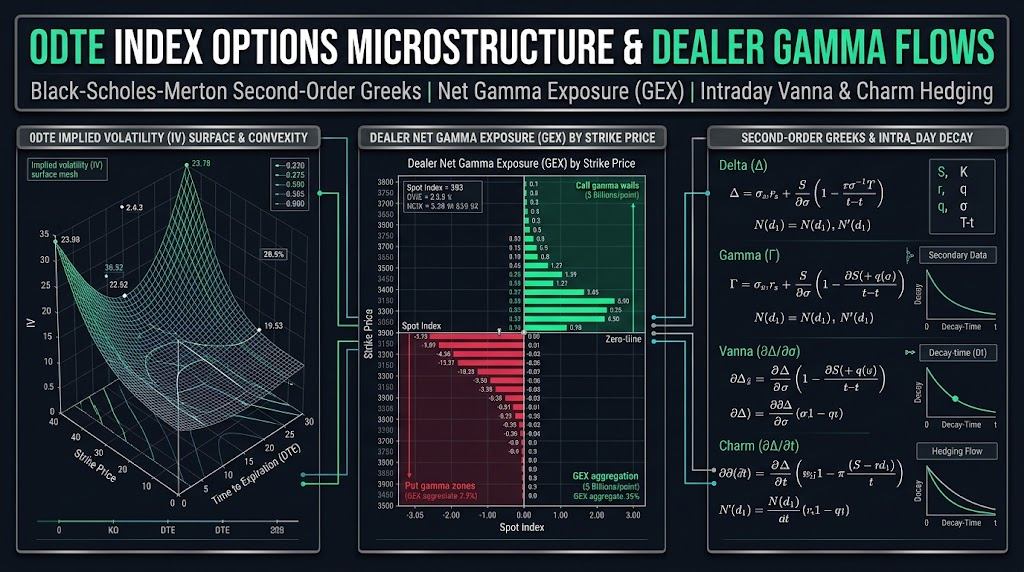
The structural expansion of daily expiration cycles across cash-settled S&P 500 Index (SPX) and Nasdaq-100 Index (NDX) options has fundamentally altered intraday equity market microstructure. Contracts expiring within the same trading session—known across institutional derivatives desks as Zero-Days-to-Expiration (0DTE) options—now command over 50% of aggregate daily index options volume. Because the remaining time to expiration ($\tau = T - t$) collapses toward zero across the 6.5-hour US cash session, first- and second-order partial derivatives of the Black-Scholes-Merton (BSM) pricing partial differential equation exhibit extreme non-linear convexity. Understanding how options market makers dynamically hedge net Gamma ($\Gamma$), Vanna, and Charm exposures via underlying E-mini S&P 500 futures (/ES) is essential for modeling intraday mean-reversion pinning and momentum cascades.
1. Asymptotic Behavior of Black-Scholes-Merton Greeks as $\tau \to 0$
Under the continuous-time Black-Scholes-Merton framework for European-style cash-settled index options with continuous dividend yield $q$ and risk-free financing rate $r$, the theoretical value of a call option $C(S, t)$ satisfies the no-arbitrage parabolic partial differential equation. As time-to-expiry approaches zero ($\tau \to 0^+$), the probability density function of the standardized log-moneyness variable $d_1$ concentrates sharply around the at-the-money (ATM) strike $K = S_t$.
Consequently, for ATM strikes where $\ln(S_t / K) \approx 0$, the rate of change of option delta with respect to spot price—Gamma ($\Gamma$)—scales inversely with the square root of remaining time ($\Gamma_{\text{ATM}} \propto \tau^{-1/2}$). Simultaneously, Charm (the sensitivity of delta to the passage of time, $-\partial \Delta / \partial \tau$) accelerates rapidly for slightly out-of-the-money (OTM) contracts, forcing options market makers (dealers) to execute continuous mechanical delta adjustments inside the central limit order book (CLOB) even when spot prices remain stationary.
$$\Gamma(S_t, \tau) = \frac{\partial^2 V}{\partial S_t^2} = \frac{e^{-q\tau}\,\phi(d_1)}{S_t\,\sigma_{\text{IV}}\sqrt{\tau}}, \qquad \phi(d_1) = \frac{1}{\sqrt{2\pi}}e^{-d_1^2 / 2}$$ Where $\sigma_{\text{IV}}$ is strike-specific implied volatility and $\phi(d_1)$ is the standard normal density. At the money ($d_1 \approx 0$), $\Gamma \to \infty$ as $\tau \to 0^+$.
$$\text{Vanna} = \frac{\partial^2 V}{\partial S_t\,\partial \sigma_{\text{IV}}} = -e^{-q\tau}\,\phi(d_1)\frac{d_2}{\sigma_{\text{IV}}}, \qquad \text{Charm} = -\frac{\partial \Delta}{\partial \tau} = -q e^{-q\tau}\Phi(d_1) + e^{-q\tau}\phi(d_1)\left(\frac{2(r-q)\tau - d_2\sigma_{\text{IV}}\sqrt{\tau}}{2\tau\sigma_{\text{IV}}\sqrt{\tau}}\right)$$ Where Vanna governs dealer delta re-hedging during intraday implied volatility crushes, and Charm dictates deterministic delta decay hedging across the trading afternoon.
2. Dealer Net Gamma Exposure ($\text{GEX}$) & Intraday Liquidity Regimes
Institutional options dealers act as warehousing intermediaries, absorbing order flow from systematic volatility-selling funds, retail speculators, and institutional tail-risk hedgers. To maintain a delta-neutral inventory book ($\Delta_{\text{portfolio}} = 0$), dealers continuously buy or sell underlying index futures (/ES) in proportion to their aggregate Net Gamma Exposure ($\text{GEX}$) across all active strikes $k \in \mathcal{K}$:
- Long Gamma Regime ($\text{GEX} > 0$ — Mean-Reverting / Pinning Market): When market makers hold a net long gamma inventory across ATM strikes, a rise in the S&P 500 spot index increases their positive option delta, requiring dealers to sell
/ESfutures into strength. Conversely, a drop in spot requires dealers to buy/ESfutures on weakness. This counter-cyclical hedging flow absorbs directional order flow, dampens realized volatility ($\sigma_{\text{RV}}$), and pins the index near high-open-interest strikes into the 4:00 PM ET cash close. - Short Gamma Regime ($\text{GEX} < 0$ — Momentum / Volatility Expansion): When dealers are net short 0DTE puts or calls, their hedging requirement reverses into a pro-cyclical feedback loop. As the market falls toward a heavy short-gamma put strike, dealer delta becomes increasingly positive (less short), forcing them to sell
/ESfutures into a falling market—draining order-book liquidity and accelerating intraday directional cascades.
3. Comparative Microstructure: Regime Dynamics Under Dealer Hedging
Quantitative execution algorithms adjust participation rates and limit-order placement based on the prevailing intraday dealer Greeks topology:
| Microstructure Parameter | Dealer Long Gamma ($\text{GEX} > 0$) | Dealer Short Gamma ($\text{GEX} < 0$) | Post-Event Vanna/Charm Flow |
|---|---|---|---|
| Dealer Futures Hedge Direction | Counter-trend (Sell rallies, Buy dips) | Pro-trend (Buy rallies, Sell selloffs) | Time- & IV-driven buying as OTM puts decay |
| CLOB Liquidity Impact | Liquidity-providing (tightens spreads) | Liquidity-consuming (widens bid-ask) | Steady upward drift (2:00 PM–3:50 PM ET) |
| Realized Volatility ($\sigma_{\text{RV}}$) | Compressed ($\sigma_{\text{RV}} \ll \sigma_{\text{IV}}$) | Amplified ($\sigma_{\text{RV}} > \sigma_{\text{IV}}$) | Rapid implied volatility compression |
4. Intraday Volatility Surface Calibration & Market-On-Close (MOC) Imbalances
Because standard annual time fractions ($\tau = D / 365$) fail to capture intraday volatility decay across discrete macro release windows (such as 8:30 AM ET CPI prints or 2:00 PM ET FOMC announcements), quantitative market-making engines parameterize 0DTE time in effective variance minutes ($\tau_{\text{eff}}$), assigning higher variance weights to the opening 30-minute auction and final 15-minute cash settlement window.
$$\Delta Q_{\text{hedge}} = -0.01 \cdot S_t^2 \sum_{k \in \mathcal{K}} M_{\text{contract}} \left( \text{OI}_{k,\text{call}}^{\text{dealer}}\,\Gamma_{k,\text{call}} + \text{OI}_{k,\text{put}}^{\text{dealer}}\,\Gamma_{k,\text{put}} \right)$$ Where $M_{\text{contract}} = 100$ is the SPX index multiplier and $\text{OI}_{k}^{\text{dealer}}$ represents signed dealer net open interest at strike $k$.
Primary Quantitative Derivatives & Exchange Microstructure References
- 1. Cboe Global Markets Exchange Documentation: S&P 500 Index Options (SPX / SPXW) Settlement Specifications, Cash-Settled Exercise Mechanics & 0DTE Microstructure.
- 2. Bank for International Settlements (BIS) Quarterly Review: Market-Maker Gamma Hedging, Short-Dated Options Proliferation, and Intraday Equity Volatility Amplification.
- 3. Internal Revenue Code (26 U.S.C. § 1256): Section 1256 Broad-Based Index Options Classification (Non-Equity Options) and 60/40 Capital Gains Accounting.
Related Quantitative Finance & Market Microstructure Research
TrendSpike Editorial Team
Staff Research & Technical AnalysisIndependent research covering distributed cloud systems, modern enterprise software engineering, and macro-financial policy. Our technical and financial analyses reference primary documentation, official regulatory filings, and benchmark architectures.