Federal Reserve Hikes Interest Rates by 25 Bps: Prime Rate and Borrowing Costs Set to Rise
The Federal Reserve raised the benchmark federal funds rate by 25 basis points to a target range of 3.75%–4.00%, pushing up the prime rate and nationwide borrowing costs.
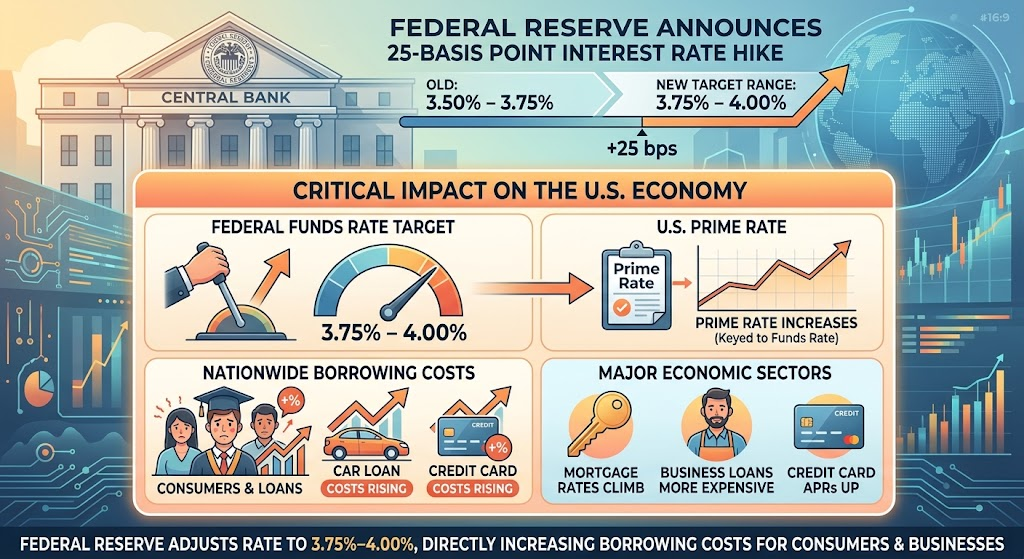
Search interest for "federal reserve interest rates" and "prime rate today" spiked over 700% after the Federal Open Market Committee (FOMC) concluded its September policy meeting by voting unanimously to raise the benchmark federal funds rate by 25 basis points. The rate hike moves the Fed's target range to 3.75% to 4.00%, marking the central bank's first rate increase since 2023.
Inflation Pressures Force the Fed's Hand
In its official monetary policy statement, the central bank cited persistent inflationary pressures, resilient consumer demand, and geopolitical energy shocks as key catalysts demanding tighter financial conditions. While domestic employment numbers have held steady, headline inflation has remained stubbornly above the committee’s long-term 2% annualized target.
The FOMC affirmed that this policy adjustment is necessary to anchor price stability and guide inflation back toward sustainable levels. Alongside the benchmark decision, the Board of Governors raised the interest rate paid on reserve balances (IORB) to 3.90% and increased the primary credit discount rate to 4.00%.
What the 25 Bps Hike Means for Consumers and Markets
The Federal Reserve does not set commercial loan rates directly, but the federal funds rate serves as the primary floor for commercial banks. As financial institutions adjust their baseline lending costs, consumers will feel the pinch across several lending channels:
- Prime Rate Adjustments: Commercial banks immediately lift the nationwide prime rate, raising baseline loan rates for top-tier corporate borrowers and personal loan facilities.
- Credit Card APRs: Variable-rate revolving credit accounts will register corresponding percentage increases within one to two billing cycles, increasing borrowing costs for balance-carrying households.
- Auto and Personal Loans: Financing terms on new vehicle purchases and fixed personal debt will absorb tighter underwriting and slightly higher borrowing spreads.
- Mortgage and Real Estate Yields: While long-term 30-year mortgages track 10-year Treasury bond yields rather than direct Fed moves, heightened expectations for extended tight policy keep mortgage rates elevated.
- High-Yield Savings: On the positive side for savers, yields on high-yield cash accounts and short-term certificates of deposit (CDs) will see marginal upward revisions.
FOMC Monetary Benchmark:
With the benchmark target lifted to 3.75%–4.00%, market participants are pricing in updated economic projections signaling the possibility of further rate scrutiny before year-end.
Market Reaction and the Path Ahead
Equity indices and bond markets experienced immediate volatility as Treasury yields repriced following the policy announcement. Investors are closely dissecting the central bank's forward guidance, monitoring consumer expenditure metrics, energy commodity swings, and quarterly corporate earnings to gauge whether additional rate hikes remain on the table for upcoming meetings.
Related Reading: Track how energy and raw commodity volatility impacts broader consumer spending in our deep dive on crude oil markets and retail fuel prices, or explore enterprise tech resiliency during market shifts in our analysis of enterprise cloud infrastructure and platform stability.
TrendSpike Editorial Team
Staff Research & Technical AnalysisIndependent research covering distributed cloud systems, modern enterprise software engineering, and macro-financial policy. Our technical and financial analyses reference primary documentation, official regulatory filings, and benchmark architectures.