What Are Stock Market Futures and How Do They Really Work?
Stop trading the cash open blind. Discover how stock market futures dictate daily price direction, how pre-market /ES and /NQ contracts work, and how institutions position before the opening bell.
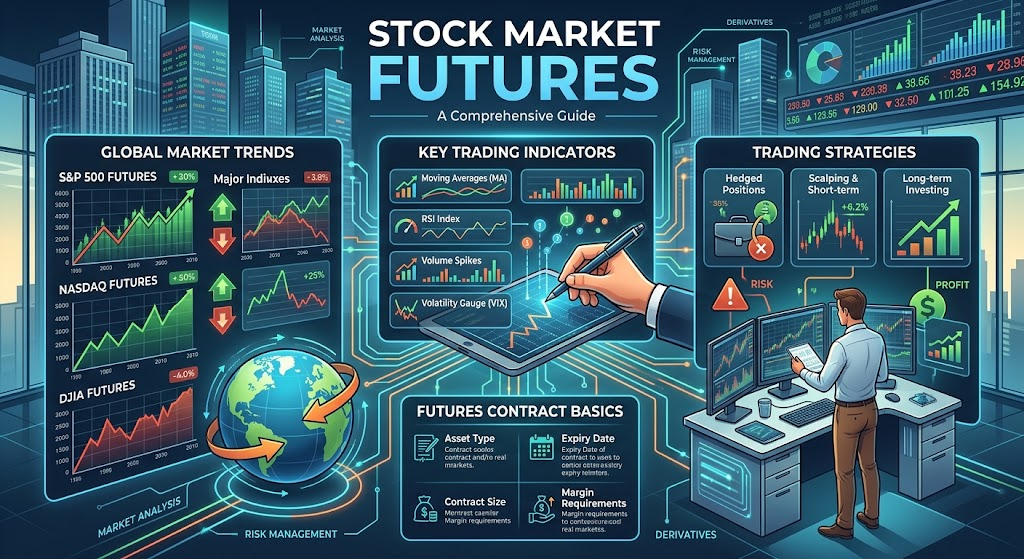
If you wake up at 9:29 AM, open your brokerage app, and try to guess where the market is heading based on yesterday’s closing price, you are already exit liquidity.
Long before the opening bell rings on the New York Stock Exchange, the real game has already played out. By the time retail traders pour their morning coffee, institutional trading desks, high-frequency algorithms, and overseas capital have spent hours pricing in overnight macroeconomic shocks, foreign wars, and pre-market corporate earnings.
The steering wheel behind all of it? Stock market futures. Here is the unfiltered breakdown of what index futures actually are, how institutional capital establishes pre-market direction, and how to read the tape before the opening bell triggers widespread retail churn.
What Is an Index Future (Without the Wall Street Jargon)?
Strip away the investment bank vocabulary, and an index future is simply a legally binding contract obligating two parties to exchange the cash value of an underlying stock index at a predetermined price on a specific expiration date.
When you buy common shares of Apple or Nvidia, you own equity. You wait for long-term price appreciation or quarterly dividend checks. When you trade index futures, you own zero physical equity. You are trading a standardized derivatives contract that settles entirely in cash.
No institution delivers 500 physical stock certificates when an S&P 500 contract expires. Instead, clearinghouses calculate who was right, debit the losing account, and credit the winner. Because these contracts trade on CME Globex almost 24 hours a day—opening Sunday evening at 6:00 PM ET and running straight through Friday afternoon—they serve as the primary conduit for absorbing macro shocks while cash exchanges remain closed.
The Big Four: Benchmark Contracts Dictating Sentiment
Institutional volume does not spread across thousands of individual equities overnight. Liquidity concentrates directly into four primary electronic contracts:
| Contract | Underlying Benchmark | Multiplier | Minimum Tick Value |
|---|---|---|---|
| /ES (E-mini S&P 500) | S&P 500 Index | $50 × Index | 0.25 pts = $12.50 |
| /NQ (E-mini Nasdaq-100) | Nasdaq-100 Tech | $20 × Index | 0.25 pts = $5.00 |
| /YM (E-mini Dow) | Dow Jones 30 | $5 × Index | 1.00 pt = $5.00 |
| /RTY (Russell 2000) | Russell 2000 Small-Caps | $50 × Index | 0.10 pts = $5.00 |
Pro Note: For smaller accounts, CME’s Micro contracts (/MES and /MNQ) trade at exactly one-tenth the size of standard E-mini contracts, offering retail accounts institutional execution access without excessive leverage.
How Futures Dictate the 9:30 AM Opening Bell
When financial headlines blast that "Dow futures are down 300 points," they are not guessing. They are measuring the spread between where futures trade right now and where the cash market settled the previous afternoon:
- The 8:30 AM Macro Window: Heavyweight economic prints—including CPI, Non-Farm Payrolls, and GDP data—cross the wires at 8:30 AM ET, a full hour before regular equity trading starts. Futures traders price the release in milliseconds. By 9:30 AM, that move is already priced in.
- Fair Value Arbitrage: Futures trade at a mathematical premium or discount known as Fair Value, factoring in interest rates minus expected stock dividends. If futures trade out of balance with Fair Value, automated institutional algorithms immediately trade the spread, forcing cash and futures prices back into lockstep at the opening bell.
- TrendSpike Morning Briefings: Serious market operators do not rely on lagging cable news commentary. Tracking index futures curves alongside pre-market volume gives you early clarity on whether an opening surge is real institutional accumulation or a retail head-fake.
Why Smart Capital Prioritizes Futures Over Cash Equities
Institutions trade index futures because physical stock markets are often slower and more capital-intensive:
- Capital Efficiency: Cash equity margin under Regulation T requires 50% equity. Futures trade on performance margin bonds (often 5% to 12% of total contract value), letting funds deploy capital tactically while keeping cash reserves yielding elsewhere.
- Surgical Hedging: If an investment manager holds an $8 million tech portfolio and the Federal Reserve announces an aggressive rate decision, dumping 30 individual stocks creates tax liabilities and execution slippage. Shorting an equivalent notional block of
/NQhedges the portfolio in a single click. - Tax Advantages: In jurisdictions like the United States, broad-market index futures qualify under Section 1256, where 60% of profits receive long-term capital gains tax treatment and 40% are taxed as short-term gains, regardless of trade duration.
The Operational Risks Retail Must Respect
High leverage cuts both ways. The exact mechanics that make futures attractive can quickly wipe out an under-capitalized account:
- Instant Margin Liquidation: Modern risk engines do not issue polite phone calls. If your account equity falls below required maintenance margin during an intraday dip, the broker’s automated risk engine liquidates your contracts via market order.
- Contract Rollovers: Equity index contracts expire quarterly in March, June, September, and December. Anyone holding multi-week positions must actively roll their exposure to the next front-month contract before cash settlement.
The Bottom Line
Stop viewing 9:30 AM as the starting line. The cash open is merely the execution phase; the overnight futures session is the blueprint. Watch /ES and /NQ volume levels, track the Fair Value spread, and enter the market aligned with where institutional capital has already laid its bets.
Related Reading: Track how broader macro volatility ripples into physical commodities in our deep-dive on how crude swings shape the pump in the US, or see how sudden real-world disruptions paralyze international travel in our breakdown of global aviation system outages and passenger delays.
TrendSpike Editorial Team
Staff Research & Technical AnalysisIndependent research covering distributed cloud systems, modern enterprise software engineering, and macro-financial policy. Our technical and financial analyses reference primary documentation, official regulatory filings, and benchmark architectures.