Linux Kernel Read-Copy-Update (RCU) Synchronization Architecture: Lockless Reader Critical Sections, Hierarchical Tree RCU Grace Periods, and Callback Offloading
An institutional systems engineering analysis of the Linux kernel Read-Copy-Update (RCU) synchronization subsystem, detailing zero-atomic-instruction reader fastpaths, pointer publication memory barriers, hierarchical Tree RCU (`rcu_node`) grace-period detection, and `nocbs` real-time callback offloading.
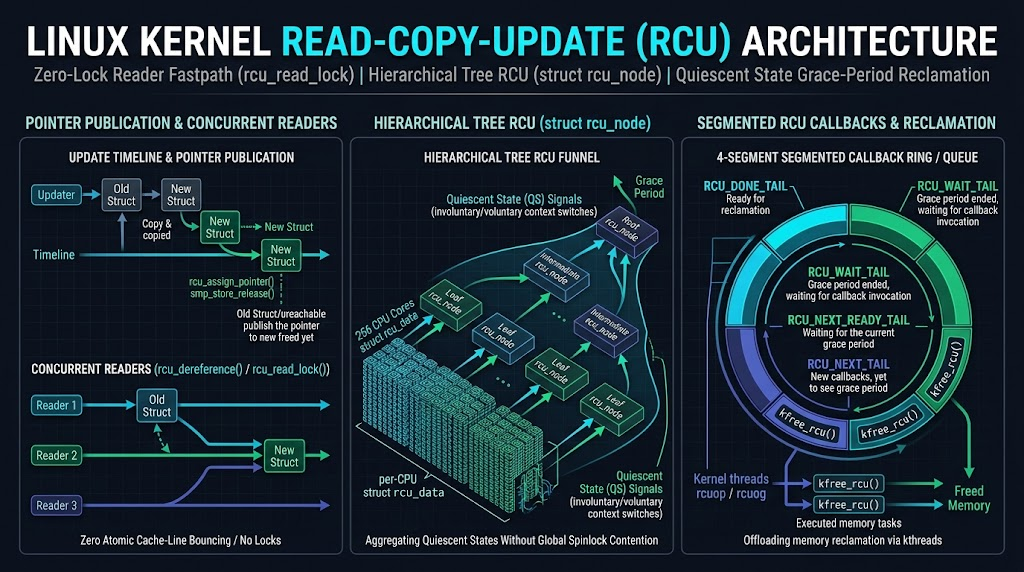
In multi-socket symmetric multiprocessing (SMP) servers scaling past $128\text{ to }512\text{ logical CPU cores}$, conventional reader-writer spinlocks (rwlock_t) and atomic reference counters (refcount_t) collapse under hardware cache-coherency traffic. Even when a workload consists of $99.9\%$ read operations—such as traversing the Linux kernel's Virtual Filesystem directory entry cache (dcache), routing tables (FIB), network namespace lists, or struct task_struct process trees—acquiring a shared read lock requires executing an atomic read-modify-write instruction (such as LOCK XADD on x86_64 or LDXR/STXR on ARM64). This forces the CPU's MESI/MOESI cache-coherency protocol to invalidate the lock's $64\text{-byte}$ cache line across every remote L1/L2 cache in the system, stalling reader pipelines for ratusan of clock cycles. Read-Copy-Update (RCU) eliminates reader-side atomic instructions, memory barriers, and cache-line bouncing entirely by splitting updates into two phases: atomic pointer publication in space and deferred reclamation after a Quiescent State Grace Period in time.
1. The Fundamental RCU Contract: Space-Based Updates & Time-Based Reclamation
Unlike mutual exclusion locks that prevent readers and writers from accessing a data structure simultaneously, Linux Kernel Read-Copy-Update (RCU) allows lockless readers to execute concurrently with an in-place writer by maintaining multiple historical versions of an object during a transition window:
- Copy & Modify Phase (Spatial Isolation): When an updater thread needs to modify an RCU-protected structure pointed to by global pointer
gp, it allocates a new structure viakmalloc()/kmem_cache_alloc(), copies the existing fields from the old structure, and mutates the private copy before any reader can observe it. - Publish Phase (
rcu_assign_pointer): The updater overwrites the shared pointer to reference the newly initialized structure usingrcu_assign_pointer(gp, new_ptr), which compiles down to a release store barrier (smp_store_release(&gp, new_ptr))—guaranteeing that all prior structure field initializations become globally visible to all CPU cores before the pointer update itself is observed. Concurrent readers executingrcu_dereference(gp)inside anrcu_read_lock()/rcu_read_unlock()section cleanly observe either the intact old structure or the fully initialized new structure without ever reading torn intermediate state. - Wait for Grace Period & Reclaim Phase (Temporal Isolation): Because pre-existing readers on remote CPU cores may still hold transient references to the old structure (`old_ptr`), the updater cannot call
kfree(old_ptr)immediately. Instead, the updater invokessynchronize_rcu()(blocking) or registers an asynchronous callback viacall_rcu(&old_ptr->rcu_head, cb_func)/kfree_rcu(). The RCU subsystem waits until every CPU core in the system has passed through at least one Quiescent State (QS)—proving no pre-existingrcu_read_lock()critical section can possibly remain active—and only then freesold_ptr.
$$C_{\text{rwlock}}(N) = T_{\text{atomic\_RMW}} + (N - 1)\,p_{\text{concurrent}} \cdot T_{\text{MESI\_invalidate}} \;\propto\; \mathcal{O}(N), \qquad C_{\text{RCU\_read}}(N) = T_{\text{register\_load}} \;\propto\; \mathcal{O}(1)$$ On non-preemptible kernels (
CONFIG_PREEMPT_NONE), rcu_read_lock() and rcu_read_unlock() generate literally zero CPU instructions ($0\text{ cycles}$), compiling purely to compiler optimization barriers (barrier()) that prevent the C compiler from reordering memory accesses across the critical section boundary.
$$\text{Global Bitmask Contention} = \mathcal{O}(N), \qquad \text{Tree RCU Leaf Contention} = \mathcal{O}(F_{\text{leaf}}) \quad \text{where } F_{\text{leaf}} \in [16, 64], \;\; D_{\text{tree}} = \lceil \log_{F}(N) \rceil$$ By partitioning $N$ per-CPU
struct rcu_data instances beneath a radix tree of struct rcu_node combiners with default leaf fanout $F_{\text{leaf}} = 16$ (and internal node fanout $32\text{ or }64$), Tree RCU caps spinlock contention at the leaf level regardless of whether the server has $64$ or $4,096$ CPUs.
2. Hierarchical Tree RCU Internals: `struct rcu_state`, `struct rcu_node` & Quiescent State Propagation
If all $N$ CPU cores attempted to clear their bit in a single global bitmask upon passing through a Quiescent State (such as a voluntary context switch, transition to user space, or idle loop), the spinlock guarding that global bitmask would become a catastrophic serialization bottleneck on large NUMA systems. To scale grace-period detection to thousands of processors, the Linux kernel implements Hierarchical Tree RCU (`kernel/rcu/tree.c`):
- Per-CPU State (
struct rcu_data): Each logical CPU core maintains a private, cache-line-alignedstruct rcu_datainstance that records local quiescent states, tracks the last grace-period sequence number observed by that CPU (`gp_seq`), and manages the CPU's local 4-segment callback queue (`cblist`). - Combining Tree Hierarchy (
struct rcu_node): Above the per-CPUrcu_dataarray sits a static tree ofstruct rcu_nodestructures embedded inside the globalstruct rcu_state. Each leafrcu_nodeaggregates quiescent-state bitmasks (`qsmask`) for a group of $16$ (or $32$) sibling CPUs belonging to the same physical socket or NUMA domain. When a CPU detects a local quiescent state during its scheduling-clock interrupt (`rcu_sched_clock_irq()`), it clears its bit in its parent leafrcu_node->qsmaskunder the leaf node's local lock. - Upward Funneling to the Root Node: Only the specific CPU that clears the very last remaining bit (`qsmask == 0`) in a leaf
rcu_nodeascends to the next level of thercu_nodetree to clear that leaf's bit in the parentrcu_node. When the final bit in the rootrcu_nodereaches zero, the Grace Period Kernel Thread (`rcu_gp_kthread`) advances the global grace-period sequence counter (`rcu_state.gp_seq`) and marks all waiting callbacks across the cluster ready for invocation.
3. Comparative Architecture of Linux Kernel Synchronization & RCU Flavors
Kernel subsystem maintainers select among five primary synchronization and RCU variants based on reader sleep requirements, real-time preemption deterministic bounds, and update frequency:
| Synchronization Primitive | Reader Critical Section Cost | Can Readers Block / Sleep? | Grace Period / ReclamationLatency | Primary Linux Kernel Subsystem Use Case |
|---|---|---|---|---|
Classic Tree RCU (PREEMPT_NONE) |
$0\text{ CPU Cycles}$ (Compiler barrier only) | No (Context switch is a Quiescent State) | $3\text{ to }20\text{ ms}$ (`synchronize_rcu()`) | VFS `dcache` path walk, IP routing FIB, `task_struct` lookup |
Preemptible RCU (CONFIG_PREEMPT_RCU) |
$\sim 2\text{ Cycles}$ (`current->rcu_read_lock_nesting++`) | Preemptible by higher-priority RT tasks, but no explicit sleep | $5\text{ to }30\text{ ms}$ (Tracks blocked readers on `rcu_node->blkd_tasks`) | Low-latency desktop, `PREEMPT_RT`, and cloud container kernels |
| Expedited RCU (`synchronize_rcu_expedited`) | Identical to standard Tree RCU ($0\text{--}2\text{ Cycles}$) | No | $20\text{ to }150\,\mu\text{s}$ (Forces immediate QS via cross-CPU IPIs) | Network device teardown (`netdev`) and hotplug state transitions |
Sleepable RCU (SRCU) |
Per-CPU counter increment + `smp_mb()` ($\sim 15\text{ Cycles}$) | Yes (Permits arbitrary blocking/page faults inside reader) | Isolated per `srcu_struct` domain (`synchronize_srcu()`) | KVM hypervisor memory slot tables (`kvm_memslots`) & notifier chains |
Sequence Locks (seqlock_t) |
Sequence counter read + `smp_rmb()` retry loop | No (Readers retry if odd sequence number detected) | Zero ($0\text{ ns}$) (In-place mutation; no allocation or GC) | `jiffies_64` system timekeeping & VFS `dentry` name comparison |
4. Segmented Callback Rings (`rcu_segcblist`) & Real-Time `rcu_nocbs` Offloading
When a kernel thread invokes call_rcu() or kfree_rcu(), the callback cannot execute immediately; it must be tagged with the exact future grace-period sequence number that will guarantee safety after all active readers finish. Each CPU's rcu_data.cblist implements a 4-segment singly-linked queue (`struct rcu_segcblist`) partitioned by four tail pointers:
RCU_DONE_TAIL: Callbacks whose target grace period has fully elapsed and are ready to be invoked immediately via software interrupt (`RCU_SOFTIRQ`).RCU_WAIT_TAIL: Callbacks waiting on the currently in-progress grace period.RCU_NEXT_READY_TAIL: Callbacks queued after the current grace period started, which are assigned to wait for the next grace period to begin.RCU_NEXT_TAIL: Newly registered callbacks that have not yet been assigned a grace-period sequence number.
In ultra-low-latency high-frequency trading (HFT), telecommunications 5G RAN, and DPDK/isolcpus workloads, executing batches of deferred RCU_DONE_TAIL callbacks inside a local CPU core's `RCU_SOFTIRQ` handler steals tens of microseconds from user-space real-time threads. By booting the Linux kernel with the rcu_nocbs=all (No-Callback CPUs) parameter, systems architects strip RCU callback execution out of `RCU_SOFTIRQ` entirely and offload all callback registration and invocation to dedicated rcuog (RCU Offload Grace-Period) and rcuop (RCU Offload Per-CPU) kernel threads pinned exclusively to housekeeping CPU cores—delivering zero-jitter execution on isolated worker cores.
Primary Linux Kernel Concurrency & RCU References
- 1. Linux Kernel Core Documentation: What is RCU? — Fundamental Read-Copy-Update Publish-Subscribe, Grace Period, and Maintain-Multiple-Versions Mechanics.
- 2. Linux Kernel Design Specification: Tree RCU Data Structures — `struct rcu_state`, Hierarchical `struct rcu_node` Combiners, `struct rcu_data`, and `rcu_segcblist`.
- 3. Linux Kernel Memory Model (LKMM): Linux Kernel Memory Barriers — `smp_store_release()`, `smp_load_acquire()`, `READ_ONCE()`, and Address-Dependency Ordering.
Related Linux Kernel & Systems Architecture Research
TrendSpike Editorial Team
Staff Research & Technical AnalysisIndependent research covering distributed cloud systems, modern enterprise software engineering, and macro-financial policy. Our technical and financial analyses reference primary documentation, official regulatory filings, and benchmark architectures.