Linux Kernel Memory Management Architecture: SLUB Allocator Per-CPU Freelist Fastpaths, 5-Level Page Table Walks, and Transparent Huge Page (THP) TLB Coherency
An institutional systems engineering analysis of the Linux kernel virtual memory subsystem, examining zonal buddy allocation, lockless per-CPU SLUB kmem_cache allocation fastpaths, 5-level LA57 hardware page-table walks, inter-processor TLB shootdown interrupts, and Transparent Huge Page (THP) compaction trade-offs.
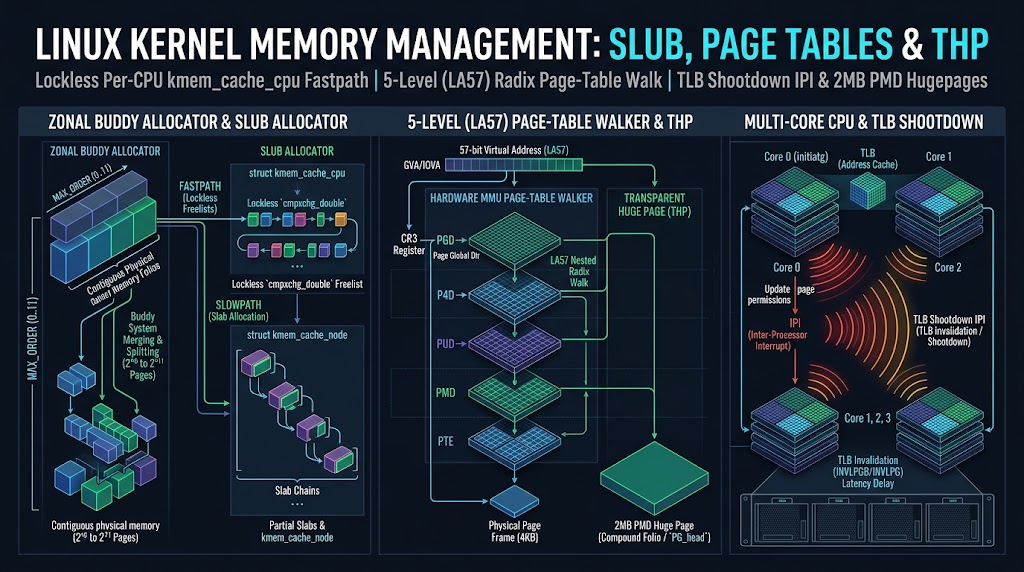
In high-throughput database storage engines, low-latency trading matching engines, and multi-terabyte in-memory caches running on modern multi-socket NUMA servers, application tail latency ($p_{99.9}$) is frequently dictated not by instruction execution throughput, but by the virtual memory translation and kernel object allocation mechanics of the Linux Kernel Memory Management (`mm`) subsystem. Every network packet buffer (struct sk_buff), virtual filesystem inode (struct inode), and virtual memory area descriptor (struct vm_area_struct) relies on sub-page kernel memory allocation, while user-space memory references depend on hardware Memory Management Unit (MMU) radix page-table walks cached inside CPU Translation Lookaside Buffers (TLBs). Eliminating microsecond allocation stalls, cross-socket NUMA lock contention, and inter-processor TLB shootdown storms requires a rigorous mastery of the Zonal Buddy Allocator, the Unqueued SLUB Slab Allocator (`struct kmem_cache_cpu`), 4-level and 5-level (LA57) hardware page-table hierarchies, and Transparent Huge Page (THP) versus explicit `hugetlbfs` memory compaction mechanics.
1. Physical Page Frame Management: NUMA Zones, Buddy Lists & `struct folio`
At the base of the Linux physical memory hierarchy, system DRAM is partitioned across Non-Uniform Memory Access (NUMA) nodes (pg_data_t / struct pglist_data) and subdivided into hardware-constrained memory zones (ZONE_DMA32, ZONE_NORMAL, and ZONE_MOVABLE). To prevent external fragmentation across physical page frames of base size $4\text{ KiB}$ ($2^{12}\text{ bytes}$ on x86_64), the kernel's Zonal Buddy Allocator maintains arrays of free physical page blocks grouped by allocation order $k \in [0, \text{MAX\_PAGE\_ORDER}]$ (typically orders $0$ through $10$, spanning $4\text{ KiB}$ single pages up to $4\text{ MiB}$ contiguous blocks of $2^{10} = 1,024$ pages).
Historically, the kernel tracked every physical $4\text{ KiB}$ frame via a $64\text{-byte}$ struct page metadata descriptor, creating ambiguity when functions accepted pointers that could refer either to a single base page or the tail page of a compound multi-page allocation. Modern Linux kernels unify multi-page physical memory management around struct folio—a type-safe wrapper guaranteed to point exclusively to the head page (`PG_head`) of a power-of-two physical memory allocation, eliminating redundant compound-head pointer dereferences (`compound_head()`) across the page cache, anonymous memory faults, and slab allocators.
$$T_{\text{mem\_eff}} = h_{\text{L1\_dTLB}}\,T_{\text{L1}} + (1 - h_{\text{L1\_dTLB}})\Big[ h_{\text{L2\_STLB}}\,T_{\text{L2}} + (1 - h_{\text{L2\_STLB}})\big(T_{\text{PWC}} + N_{\text{levels}}(1 - h_{\text{PWC}})\,T_{\text{cache/DRAM}}\big)\Big]$$ Where $h_{\text{L1\_dTLB}}$ and $h_{\text{L2\_STLB}}$ are the L1 Data TLB and L2 Shared TLB hit ratios, $N_{\text{levels}} \in \{4, 5\}$ is the radix page-table depth ($48\text{-bit}$ vs. $57\text{-bit}$ LA57 virtual addressing), and $h_{\text{PWC}}$ is the MMU Page-Walk Cache hit rate. Promoting $4\text{ KiB}$ PTE mappings to $2\text{ MiB}$ PMD hugepages expands TLB reach by $512\times$ and reduces $N_{\text{levels}}$ by one full indirection step.
$$C_{\text{shootdown}}(P) = T_{\text{APIC\_send}} + \max_{i \in \{1..P\}}\!\left(T_{\text{IPI\_wakeup}}^{(i)} + T_{\text{INVLPG}}^{(i)}\right) + T_{\text{cpumask\_ack}} \;\propto\; \mathcal{O}(\log P \text{ to } P)$$ Where $P$ is the number of active CPU cores sharing the process
mm_struct mask (`mm_cpumask(mm)`), $T_{\text{APIC\_send}}$ is local x2APIC interrupt dispatch overhead, and $T_{\text{INVLPG}}^{(i)}$ is remote core pipeline serialization during virtual address invalidation.
2. The Unqueued SLUB Allocator: Lockless Per-CPU `kmem_cache_cpu` Fastpaths
Because the Zonal Buddy Allocator operates strictly at page granularity ($\ge 4\text{ KiB}$), allocating sub-page kernel structures (such as a $256\text{-byte}$ struct sk_buff header or a $192\text{-byte}$ struct dentry) directly from the buddy system would waste over $90\%$ of system RAM to internal fragmentation. To serve high-frequency object allocations in $\sim 15\text{ to }35\text{ CPU cycles}$, the Linux kernel defaults to the Unqueued SLUB Allocator, which eliminates the complex per-CPU queue arrays of legacy SLAB in favor of a three-tier lockless hierarchy per slab cache (struct kmem_cache):
- Tier 1 — Lockless Per-CPU Active Slab (
struct kmem_cache_cpu): Each logical CPU core owns a privatekmem_cache_cpustructure pointing to a currently active slab folio (page) and a lockless singly-linked list of free objects (freelist). When kernel code invokeskmem_cache_alloc()on the fastpath, the CPU atomically pops the head object offc->freelistusing a lockless double-word compare-and-swap instruction (this_cpu_cmpxchg_doubleon the pointer and transaction IDtid)—requiring zero spinlocks and zero disabling of hardware interrupts. - Tier 2 — Per-Core Partial Slab List (
c->partial): When the active per-CPU slab'sfreelistis exhausted (`NULL`), SLUB checks the CPU's local list of partially full slabs (kmem_cache_cpu->partial). If available, the head partial slab is promoted to become the new active CPU slab without touching cross-core locks. - Tier 3 — Per-NUMA-Node Partial Slab List (
struct kmem_cache_node): Only when both the per-CPU active freelist and per-CPU partial list are empty does execution enter the slowpath (___slab_alloc()), acquiring the per-NUMA-node spinlock (n->list_lock) to pull a batch of partial slabs fromkmem_cache_node, or invokingalloc_pages()from the Zonal Buddy Allocator to initialize a brand-new slab folio.
3. Hardware Radix Page Tables (4-Level vs. 5-Level LA57) & Hugepage Topologies
On 64-bit x86_64 and ARM64 architectures, user-space and kernel virtual addresses are translated into physical DRAM addresses via a hardware-walked multi-level radix tree rooted in the CPU's control register (CR3 on x86_64; TTBR0_EL1 / TTBR1_EL1 on ARM64). Standard 4-level paging translates a $48\text{-bit}$ virtual address space ($256\text{ TiB}$) across four $9\text{-bit}$ table indices ($512$ entries of $8\text{ bytes}$ per $4\text{ KiB}$ table page): Page Global Directory (PGD) $\to$ Page Upper Directory (PUD) $\to$ Page Middle Directory (PMD) $\to$ Page Table Entry (PTE). On massive memory servers configured with Intel 5-Level Paging (LA57, $128\text{ PiB}$ virtual address space), the kernel inserts a fifth level—the Page 4th Directory (P4D)—between PGD and PUD.
To prevent workloads with multi-hundred-gigabyte working sets from suffering constant L2 STLB misses (each triggering a $4\text{- or }5\text{-memory-reference}$ hardware page walk), the kernel short-circuits the radix tree at the PMD level ($2\text{ MiB}$ hugepage) or PUD level ($1\text{ GiB}$ gigantic page) by setting the hardware Page Size (`PS` / `PSE`) bit:
| Paging / Hugepage Mechanism | Page Granularity & Radix Level | TLB Coverage (1,536-Entry STLB) | Allocation & Compaction Overhead | Swappability & Splitting |
|---|---|---|---|---|
| Standard Base Pages | $4\text{ KiB}$ (Level-4 PTE Leaf) | $6\text{ MiB}$ working set reach | Order-0 Buddy Fastpath ($\sim 50\text{ ns}$, zero compaction stall) | Fully swappable; fine-grained madvise(MADV_DONTNEED) |
| Multi-Size THP (mTHP, Linux 6.8+) | $16\text{ KiB} \text{ to } 64\text{ KiB}$ Contiguous PTEs | $24\text{ MiB} \text{ to } 96\text{ MiB}$ (via ARM64 Contiguous Bit / TLB coalescing) | Order-2 to Order-4 Buddy allocation (Low fragmentation risk) | Swappable without PMD split storms; low internal bloat |
| Transparent Huge Pages (PMD THP) | $2\text{ MiB}$ (Level-3 PMD Leaf, Order-9) | $3.0\text{ GiB}$ working set reach ($512\times$ base) | Synchronous direct compaction on fault (if always) or background khugepaged |
Dynamically split into $512\times 4\text{ KiB}$ PTEs via split_huge_page() |
Explicit hugetlbfs / MAP_HUGETLB |
$2\text{ MiB}$ (PMD) or $1\text{ GiB}$ (Level-2 PUD Leaf) | Up to $1.5\text{ TiB}$ (with $1\text{ GiB}$ PUD entries) | Reserved at boot time (`hugepagesz=1G`); zero runtime compaction | Pinned in physical RAM; non-swappable, supports PMD page-table sharing |
4. Transparent Huge Page (THP) Compaction Stalls & TLB Shootdown Mitigation
While Transparent Huge Pages (THP) automatically promote anonymous memory regions into $2\text{ MiB}$ PMD mappings without requiring application source-code changes, setting /sys/kernel/mm/transparent_hugepage/enabled to always coupled with aggressive synchronous defragmentation introduces two well-documented tail-latency hazards in latency-sensitive databases (such as Redis,RocksDB, and PostgreSQL):
- Synchronous Direct Compaction Stalls on Page Faults: After hours of uptime, physical RAM fragments into non-contiguous $4\text{ KiB}$ pages. When a thread triggers an anonymous page fault and attempts to allocate an Order-9 ($2\text{ MiB}$ contiguous) folio with
defrag=always, the faulting thread synchronously invokes the kernel memory compaction scanner (compact_zone())—migrating movable pages across physical frames and stalling the application thread for $5\text{ to }40\text{ ms}$. Production systems mitigate this by configuringenabled=madviseanddefrag=defer+madvise, waking the asynchronous background kernel daemon (kcompactdandkhugepaged) while immediately falling back to a $4\text{ KiB}$ PTE if an Order-9 block is not instantly free. - Copy-on-Write (`fork()`) Amplification & TLB Shootdown Storms: When a memory-intensive process executes
fork()(e.g., for background persistence snapshots) or callsmunmap()/madvise(MADV_DONTNEED)on a $4\text{ KiB}$ sub-slice of a $2\text{ MiB}$ THP, the kernel must invokesplit_huge_pmd()to shatter the single PMD entry into $512$ individual $4\text{ KiB}$ PTEs. Updating or unmapping shared page-table entries forces the kernel to issue synchronous TLB Shootdown Inter-Processor Interrupts (IPIs) viaflush_tlb_mm_range()across every CPU core running threads of that process—halting remote execution pipelines until all cores execute hardwareINVLPG/INVLPGBinstructions and acknowledge the shootdown barrier.
Primary Linux Kernel & Hardware Architecture References
- 1. Linux Kernel Core Documentation: The SLUB Unqueued Slab Allocator — Per-CPU Lockless Freelists, Partial Slab Management, and `kmem_cache` Internals.
- 2. Linux Kernel Virtual Memory Subsystem: Transparent Hugepage Support (THP), Multi-Size THP (mTHP), `khugepaged` Collapse Scanning, and Defragmentation Modes.
- 3. Intel 64 and IA-32 Architectures Software Developer's Manual (Volume 3A): 4-Level and 5-Level (LA57) Radix Paging Structures, Translation Lookaside Buffers (TLBs), and Page-Walk Caches.
Related Linux Kernel & Systems Architecture Research
TrendSpike Editorial Team
Staff Research & Technical AnalysisIndependent research covering distributed cloud systems, modern enterprise software engineering, and macro-financial policy. Our technical and financial analyses reference primary documentation, official regulatory filings, and benchmark architectures.