IRC Section 382 Net Operating Loss (NOL) Ownership Change Limitations: 5-Percent Shareholder Testing, Long-Term Tax-Exempt Rate Caps, and NUBIG Built-In Gain Mechanics
An institutional M&A corporate tax and ASC 740 accounting analysis of Internal Revenue Code Section 382, examining the 50-percentage-point ownership shift threshold, IRS long-term tax-exempt rate annual absorption caps, and Notice 2003-65 Section 338 Recognized Built-In Gain (RBIG) enhancements.
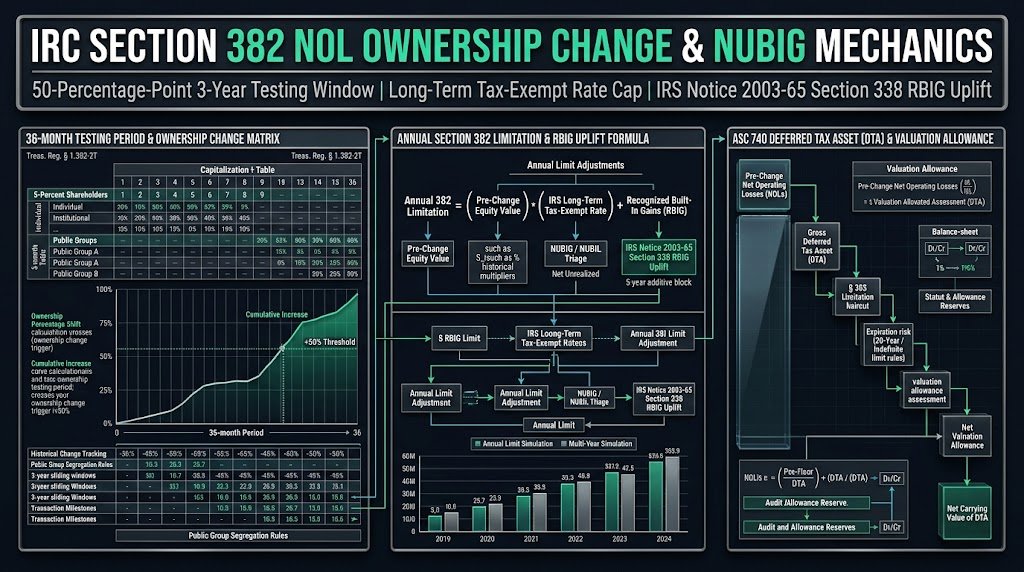
In distressed corporate mergers, venture capital down-rounds, and Chapter 11 bankruptcy reorganizations, accumulated Net Operating Loss (NOL) carryforwards and disallowed IRC Section 163(j) business interest attributes often represent one of the most valuable assets on a target corporation's balance sheet. To prevent profitable acquirers from trafficking in tax-loss shell corporations strictly to shelter unrelated operating income, Internal Revenue Code (IRC) Section 382 (26 U.S.C. § 382) imposes a severe annual ceiling on the utilization of pre-change tax attributes whenever a "Loss Corporation" undergoes a qualifying Ownership Change. Structuring M&A transactions and computing ASC 740 Deferred Tax Asset (DTA) valuation allowances requires rigorous modeling of rolling 3-year 5-Percent Shareholder shifts, the monthly IRS Long-Term Tax-Exempt Rate, and the Net Unrealized Built-In Gain (NUBIG) uplift elections under IRS Notice 2003-65.
1. Triggering the Statutory Cap: The 50-Percentage-Point Ownership Change Test
Pursuant to IRC Section 382(g) and Temporary Treasury Regulation § 1.382-2T, an ownership change occurs on any Testing Date (any date on which a loss corporation issues stock, redeems shares, or undergoes an equity shift involving a 5-Percent Shareholder) if the cumulative percentage of stock of the loss corporation owned by one or more 5-percent shareholders has increased by more than 50 percentage points over the lowest percentage of stock owned by such shareholders at any time during the rolling 3-Year Testing Period.
Computing this shift requires navigating three complex aggregation and constructive ownership doctrines under IRC Section 318 and Section 382(k)(6):
- Public Group Segregation Rules: Shareholders owning less than $5\%$ of the corporation's fair market value are aggregated into a single fictional 5-percent shareholder ("Public Group 1"). However, when the corporation executes a secondary public equity offering or stock-for-stock acquisition, the newly issued shares are segregated into a distinct "Public Group 2" whose ownership increases from $0\%$, directly consuming the 50-percentage-point buffer unless mitigated by the Small Issuance or Cash Issuance Exceptions under Treas. Reg. § 1.382-3(j).
- Value Fluctuation Insulation (IRC § 382(l)(3)(C)): In multi-class capital structures containing preferred and common shares, changes in proportionate fair market value driven purely by fluctuations in market stock prices are disregarded on subsequent testing dates unless paired with an affirmative equity transaction.
$$\Delta \Omega_{\text{Total}}(t) = \sum_{i \in \mathcal{S}_{5\%}} \max\!\left(0, \; \omega_i(t) - \min_{\tau \in [t - 3\text{ yrs}, \, t]} \omega_i(\tau)\right) > 50.00\%$$ Where $\mathcal{S}_{5\%}$ is the set of all direct and segregated public 5-percent shareholders, and $\omega_i(t)$ is shareholder $i$'s percentage ownership by fair market value on testing date $t$.
$$L_{382, t} = \underbrace{\left( V_{\text{Equity}}^{\text{Adjusted}} \times r_{\text{LTTE}} \right)}_{\text{Base Annual Cap}} + \underbrace{\text{RBIG}_{t} \;\; (\text{for } t \in [1, 5]\text{ if } \text{NUBIG} > \tau_{\text{de minimis}})}_{\text{5-Year Recognition Period Uplift}}$$ Where $V_{\text{Equity}}^{\text{Adjusted}}$ is pre-change equity value reduced by anti-stuffing capital contributions (IRC § 382(l)(1)) and non-business assets, and $r_{\text{LTTE}}$ is the IRS Long-Term Tax-Exempt Rate published monthly under Revenue Rulings pursuant to IRC § 1274(d).
2. Base Limitation Valuation: Anti-Stuffing Rules & Continuity of Business Enterprise (COBE)
Once an ownership change is triggered on the Change Date, the maximum pre-change NOL (and pre-change disallowed Section 163(j) interest carryforward under IRC § 382(d)(3)) that may offset post-change taxable income in any subsequent year is capped at the fair market value of the old loss corporation's stock immediately prior to the ownership change multiplied by the applicable Long-Term Tax-Exempt Rate ($r_{\text{LTTE}}$) (typically ranging between $3.0\%$ and $3.8\%$).
To prevent acquirers from artificially inflating $V_{\text{Equity}}$ prior to the change date, the statute enforces three strict downward valuation adjustments:
- Continuity of Business Enterprise (COBE — IRC § 382(c)): If the post-change corporation fails to continue the historic business of the old loss corporation (or use a significant portion of its historic business assets) at all times during the 2-Year Period following the change date, the annual Section 382 limitation drops retroactively to zero ($\mathbf{\$0}$)—permanently destroying the entire pre-change NOL balance.
- 2-Year Anti-Stuffing Rule (IRC § 382(l)(1)): Any capital contribution made to the loss corporation as part of a plan to increase the Section 382 limitation—including all capital infusions received during the 2-year period ending on the Change Date—is mandatorily subtracted from $V_{\text{Equity}}$.
- Substantial Non-Business Assets Reduction (IRC § 382(l)(4)): If at least one-third ($\ge 33.33\%$) of the total fair market value of the loss corporation's gross assets consists of passive cash and marketable securities ("non-business assets"), $V_{\text{Equity}}$ is reduced by the fair market value of those non-business assets net of their proportionate share of corporate liabilities.
3. NUBIG vs. NUBIL: IRS Notice 2003-65 Safe-Harbor Methodologies
Under IRC Section 382(h), if the fair market value of the loss corporation's assets immediately before the ownership change exceeds their aggregate adjusted tax basis by more than the statutory de minimis threshold (the lesser of $\$10\text{ million}$ or $15\%$ of gross asset value), the corporation possesses a Net Unrealized Built-In Gain (NUBIG). Any Recognized Built-In Gain (RBIG) realized during the 5-Year Recognition Period following the change date increases the annual Section 382 limitation dollar-for-dollar (up to the total NUBIG ceiling).
Under landmark IRS Notice 2003-65, taxpayers may elect between two safe-harbor methodologies to calculate RBIG—with the Section 338 Approach allowing corporations to generate massive synthetic RBIG uplifts without actually selling their underlying intellectual property or fixed assets:
| Built-In Gain / Loss Parameter | Section 1374 Approach (Actual Disposition) | Section 338 Approach (Hypothetical Wasting Asset) |
|---|---|---|
| RBIG Recognition Trigger | Requires actual sale or taxable disposition of built-in gain asset within 5 years | Deemed recognized annually even if the asset is retained and never sold |
| Synthetic Goodwill / IP Uplift Formula | Zero synthetic uplift from unamortized self-created goodwill or IP | Hypothetical IRC § 197 15-year amortization ($\frac{1}{15}\text{th}$ of built-in IP gain per year) |
| 5-Year Cumulative Cap Uplift | Limited strictly to actual capital gains and accrued pre-change income | Unlocks up to $5/15 = 33.33\%$ of total enterprise NUBIG automatically over 5 years |
| Optimal Taxpayer Profile | NUBIL (Net Unrealized Built-In Loss) corporations minimizing RBIL disallowances | High-valuation technology & biotech NUBIG targets with self-created zero-basis IP |
4. Chapter 11 Bankruptcy Exceptions: IRC Section 382(l)(5) vs. Section 382(l)(6)
When an insolvent corporation restructures via a Chapter 11 debt-for-equity swap in bankruptcy court, legacy bondholders typically receive $>50\%$ of the reorganized equity, triggering a Change Date. The Code provides two mutually exclusive bankruptcy regimes:
- IRC Section 382(l)(5) ("Bankruptcy Exception" — Zero Annual Cap): If pre-change shareholders and qualified historic creditors ("old and cold" debt held for at least 18 months prior to filing) retain at least $50\%$ of the reorganized voting power and value, the annual Section 382 limitation does not apply at all ($L_{382} = \infty$). However, the corporation must reduce its NOL carryforwards by the past 3 years of interest deductions paid on the converted debt, and if a second ownership change occurs within 2 years after emerging from bankruptcy, the Section 382 limitation drops permanently to zero.
- IRC Section 382(l)(6) ("Elective Debt-Cancellation Valuation Uplift"): If the reorganized debtor elects out of § 382(l)(5) (or fails the historic creditor test), § 382(l)(6) permits the corporation to calculate its pre-change equity value $V_{\text{Equity}}$ after reflecting the increase in net equity value resulting from the cancellation of indebtedness in the Chapter 11 plan—substantially increasing the annual $V_{\text{Equity}} \times r_{\text{LTTE}}$ cap without risking a subsequent two-year forfeiture cliff.
Primary Statutory & M&A Corporate Tax References
- 1. United States Code & Treasury Regulations: 26 U.S.C. § 382 & 26 CFR § 1.382-2T — Limitation on Net Operating Loss Carryforwards and Certain Built-In Losses Following Ownership Change.
- 2. Internal Revenue Service (IRS) Administrative Guidance: IRS Notice 2003-65 (2003-2 C.B. 747) — Safe Harbor Approaches (Section 1374 and Section 338) for Built-In Gains and Losses Under IRC Section 382(h).
- 3. Financial Accounting Standards Board (FASB): FASB ASC 740 (Income Taxes) — Deferred Tax Asset (DTA) Realizability Modeling & Section 382 Valuation Allowance Recognition.
Related Corporate Tax & Institutional Finance Research
TrendSpike Editorial Team
Staff Research & Technical AnalysisIndependent research covering distributed cloud systems, modern enterprise software engineering, and macro-financial policy. Our technical and financial analyses reference primary documentation, official regulatory filings, and benchmark architectures.