Hardware I/O Virtualization and IOMMU DMA Remapping Architecture: PCIe SR-IOV, Two-Stage Nested Page Tables, and ATS/PRI Device IOTLB Coherency
An institutional systems architecture analysis of hardware-assisted I/O virtualization, detailing PCIe Single-Root I/O Virtualization (SR-IOV) Virtual Functions, Intel VT-d and ARM SMMUv3 two-stage nested DMA translation, Process Address Space IDs (PASID), and PCIe Address Translation Services (ATS) IOTLB coherency.
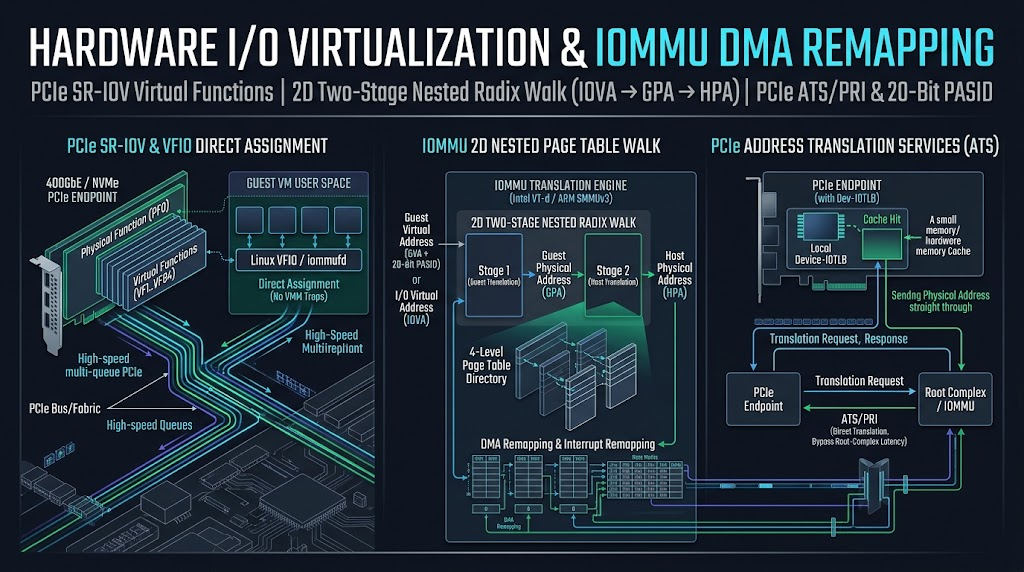
In bare-metal cloud infrastructure, multi-tenant Kubernetes container sandboxes (such as Kata Containers and AWS Firecracker), and virtualized AI training clusters, assigning high-throughput PCIe Gen 5/6 devices—such as 400GbE RDMA Network Interface Cards (NICs), NVMe storage controllers, and GPU accelerators—directly to untrusted guest virtual machines (VMs) presents a fundamental hardware security and latency dilemma. Paravirtualized software I/O queues (such as virtio-net and virtio-blk) enforce hypervisor isolation by trapping guest descriptor ring doorbells into the host Virtual Machine Monitor (VMM), but this incurs expensive VM-Exit/VM-Entry context switches (`VMX non-root` to `VMX root` transitions) that consume $1,200\text{ to }3,500\text{ CPU cycles}$ per interrupt. Eliminating the hypervisor from the fast I/O datapath while strictly preventing rogue Direct Memory Access (DMA) attacks requires coordinating PCIe Single-Root I/O Virtualization (SR-IOV), Input-Output Memory Management Unit (IOMMU) two-stage nested page tables (Intel VT-d Scalable Mode and ARM SMMUv3), 20-bit Process Address Space Identifiers (PASID), and PCIe Address Translation Services (ATS).
1. PCIe SR-IOV & Scalable IOV: Bypassing Hypervisor Trap-and-Emulate Overhead
When a guest operating system interacts with an emulated PCIe device in QEMU/KVM, every Memory-Mapped I/O (MMIO) register write to a transmit/receive doorbell triggers an Extended Page Table (EPT) violation (`EPT_MISCONFIG`), halting the physical CPU core and transferring execution to the host kernel. At $10\text{ Million IOPS}$ or $400\text{ Gbps}$ line rates, trap-and-emulate overhead saturates multiple host CPU cores purely with virtualization bookkeeping.
The PCI-SIG Single-Root I/O Virtualization (SR-IOV) specification eliminates software device emulation by partitioning a single physical PCIe endpoint into multiple hardware-isolated PCIe functions sharing a common physical link and switch port:
- Physical Functions (PFs): Full-featured PCIe functions discovered, configured, and managed exclusively by the privileged host hypervisor driver. The PF owns global ASIC resources, firmware management queues, and the SR-IOV Extended Capability structure in PCIe Configuration Space.
- Virtual Functions (VFs): Lightweight, hardware-sliced PCIe functions (up to $256$ VFs per PF) associated with the Physical Function. Each VF possesses its own independent PCIe Requester ID (`Bus:Device.Function` or 16-bit BDF), dedicated MMIO Base Address Registers (BARs) for transmit/receive queue doorbells, and isolated MSI-X interrupt vectors, while lacking privilege to alter global ASIC configuration.
- Scalable IOV (S-IOV) & Linux
iommufd/ VFIO Direct Assignment: Because classic SR-IOV duplicates full PCIe Configuration Space headers per VF in silicon (limiting scale to $\sim 64\text{--}256$ VFs), modern Scalable IOV replaces coarse BDF-level slicing with fine-grained Assignable Device Interfaces (ADIs) tagged with a 20-bit Process Address Space ID (PASID). Using the Linux kernel'sVFIOand moderniommufdsubsystem, the hypervisor maps a VF's or ADI's physical MMIO doorbell page directly into the guest VM's Extended Page Table (Stage-2 EPT), enabling guest user-space applications to ring hardware NIC/NVMe doorbells in $\sim 45\text{ ns}$ with zero hypervisor involvement.
$$M_{\text{nested}}(L_1, L_2) = L_1 \cdot L_2 + L_1 + L_2, \qquad \text{For } L_1 = 4 \text{ (48-bit GVA)}, \; L_2 = 4 \text{ (48-bit GPA)}: \;\; M_{\text{nested}}(4, 4) = 4(4) + 4 + 4 = 24 \text{ DRAM Accesses}$$ Where $L_1$ is the Stage-1 guest page-table depth ($\text{GVA} \to \text{GPA}$) and $L_2$ is the Stage-2 hypervisor EPT/NPT depth ($\text{GPA} \to \text{HPA}$). Because each Stage-1 page-table pointer is itself a Guest Physical Address ($\text{GPA}$), resolving each of the $L_1$ levels requires a full $L_2$-step Stage-2 translation walk on an IOTLB miss.
$$T_{\text{DMA\_eff}} = h_{\text{DevIOTLB}}\,T_{\text{ATS\_hit}} + (1 - h_{\text{DevIOTLB}})\Big[ h_{\text{IOMMU}}\,T_{\text{IOMMU\_hit}} + (1 - h_{\text{IOMMU}})\big(T_{\text{PCIe\_RTT}} + M_{\text{nested}} \cdot T_{\text{DRAM}}\big)\Big]$$ Where $h_{\text{DevIOTLB}}$ is the endpoint Device-IOTLB hit ratio, $h_{\text{IOMMU}}$ is the Root-Complex IOMMU TLB plus Page-Walk Cache (PWC) hit ratio, and $T_{\text{DRAM}} \approx 75\text{ ns}$ is uncached host DRAM access latency.
2. IOMMU DMA Remapping Internals: Two-Stage Nested Translation (Intel VT-d & ARM SMMUv3)
When a guest VM is granted direct MMIO access to a PCIe Virtual Function, the guest driver programs DMA descriptors using its own internal memory addresses—either Guest Physical Addresses (GPAs) or process-specific Guest Virtual Addresses (GVAs) under Shared Virtual Memory (SVM). If the PCIe endpoint issued raw DMA read/write TLP packets directly to host DRAM using guest-supplied addresses, a malicious guest could overwrite the host hypervisor kernel or exfiltrate memory belonging to neighboring VMs.
To enforce cryptographic-grade memory isolation at wire speed, the CPU Root Complex interposes a hardware Input-Output Memory Management Unit (IOMMU)—implemented as Intel Virtualization Technology for Directed I/O (VT-d Rev 4.1) on x86_64 servers and the ARM System Memory Management Unit (SMMUv3.3) on cloud-native ARM64 processors—between all PCIe root ports and the system coherency fabric:
- Device Identification via BDF & 20-Bit PASID Lookup: Every upstream PCIe Memory Read/Write Transaction Layer Packet (TLP) carries the device's 16-bit Requester ID (`Bus:Device.Function` / StreamID in ARM SMMUv3) and an optional PCIe TLP Prefix containing a 20-bit Process Address Space ID (PASID / SubstreamID). The IOMMU indexes its Root/Context Table (or Stream Table in SMMUv3) using the BDF and PASID to locate the exact translation structures authorized for that specific virtual function and user-space process.
- Stage-1 Translation ($\text{GVA / IOVA} \to \text{GPA}$): Managed directly by the guest OS kernel (via a guest vIOMMU or CPU process `CR3` page-table sharing under Shared Virtual Addressing). Stage-1 translates per-process virtual addresses or guest `dma_map_sg()` I/O Virtual Addresses (IOVAs) into Guest Physical Addresses.
- Stage-2 Translation ($\text{GPA} \to \text{HPA}$): Managed exclusively by the host hypervisor (`KVM` / `iommufd`). Stage-2 maps the intermediate Guest Physical Address into the true Host Physical Address (HPA) in server DRAM. As shown in Equation 1, an uncached 4-level-by-4-level nested walk requires up to $24$ memory accesses unless mitigated by multi-tier IOMMU Page-Walk Caches (PWCs) and $2\text{ MB} / 1\text{ GB}$ hugepage mappings.
3. Comparative Architecture of I/O Virtualization & IOMMU Operating Modes
Cloud infrastructure architects balance I/O throughput, tail latency, and live-migration flexibility across four distinct PCIe virtualization and IOMMU translation topologies:
| I/O Virtualization Mode | IOMMU Translation Path | Doorbell / Interrupt Path | IOTLB Miss Penalty | Primary Production Use Case |
|---|---|---|---|---|
Paravirtualized virtio / vhost-user |
Host software ring copy or vIOMMU shadow tables | Hypervisor VM-Exit or dedicated host polling thread | N/A (Software GPA-to-HVA lookup) | General-purpose cloud VMs requiring seamless live migration |
| SR-IOV + Stage-2 Only (GPA Direct) | 1D Walk: $\text{GPA} \to \text{HPA}$ ($4$ steps; $2\text{ MB}/1\text{ GB}$ hugepages) | Direct VF MMIO BAR + Posted Interrupts (VT-d PI / GICv4) | Low ($\sim 150\text{--}300\text{ ns}$ with 1GB hugepage pinning) | DPDK / SPDK kernel-bypass networking & NVMe storage nodes |
| SR-IOV + 2-Stage Nested (vIOMMU) | 2D Nested Walk: $\text{IOVA} \to \text{GPA} \to \text{HPA}$ (Up to $24$ steps) | Direct VF MMIO BAR + Hardware Posted Interrupts | High ($800\text{ ns--}1.8\,\mu\text{s}$ without ATS / PWC hits) | Zero-trust guest VMs running untrusted user-space DMA drivers |
| Scalable IOV + SVA (PASID + ATS/PRI) | Shared CPU/IOMMU Page Tables ($\text{GVA + PASID} \to \text{HPA}$) | User-space ENQCMD / Dedicated ADI Doorbell |
Mitigated by on-NIC/GPU Device-IOTLB (PCIe ATS) | Multi-tenant AI/GPU accelerators & CXL 3.1 memory pooling |
4. PCIe Address Translation Services (ATS), Page Request Interface (PRI) & IOTLB Invalidation Storms
When hundreds of SR-IOV Virtual Functions fire concurrent scatter-gather DMA requests across a $64\text{ GT/s}$ PCIe 6.0 root port, routing every single DMA packet through the centralized Root-Complex IOMMU TLB creates a severe lookup bottleneck. Worse, when a Linux guest kernel unmaps a DMA buffer (`dma_unmap_single()`), it must issue a synchronous IOTLB Invalidation command to flush stale translations before freeing the underlying physical page—preventing use-after-free DMA vulnerabilities.
To scale translation throughput and eliminate centralized IOMMU queueing stalls, modern endpoints implement three cooperative PCI-SIG extensions:
- PCIe Address Translation Services (ATS): Allows an endpoint NIC or GPU to maintain a local on-chip Device-IOTLB (Dev-IOTLB). Before issuing a DMA payload transfer, the endpoint sends an ATS Translation Request TLP to the Root-Complex IOMMU, caches the resulting Host Physical Address in its local SRAM Dev-IOTLB, and subsequently transmits raw DMA read/write packets with the TLP header bit
AT = 10b(Translated)—allowing the Root Complex to bypass IOMMU page-table walks entirely on the fast path. - Page Request Interface (PRI) for Demand Paging: Under Shared Virtual Addressing (SVA) with PASID, an accelerator can access standard pageable user-space memory (`malloc()`) without requiring upfront memory pinning (`mlock()`). If the IOMMU encounters an unmapped page during a walk, instead of raising a fatal PCIe Unsupported Request (UR) error, the endpoint issues a PCIe PRI Page Request to the OS kernel, which pages in the virtual memory frame asynchronously and returns a PRI Page Response while other PASID queues continue executing.
- Lazy Deferred Invalidation (
iommu.strict=0) vs. Synchronous Flush Storms: When an endpoint caches translations via ATS, an IOTLB flush requires a full PCIe round-trip handshake (Invalidation Request TLP $\to$ Device-IOTLB purge $\to$ Invalidation Completion TLP) taking $1.5\text{ to }10\,\mu\text{s}$. High-throughput Linux storage and networking stacks mitigate synchronous flush stalls by batching unmapped IOVAs into per-CPU flush rings (`fq_ring`), amortizing a single global IOTLB invalidation barrier across up to $256$ freed DMA buffers.
Primary Hardware Virtualization & Interconnect References
- 1. Intel Corporation Hardware Specification: Intel Virtualization Technology for Directed I/O (VT-d) Architecture Specification Rev 4.1 — Scalable Mode, Two-Stage Nested Translation & Posted Interrupts.
- 2. ARM Architecture Reference Manual (IHI 0070): ARM System Memory Management Unit Architecture Specification (SMMUv3.3) — StreamID/SubstreamID Tables, Stage-1/Stage-2 Walks, and Command Queues.
- 3. PCI-SIG Base Specification & Linux Kernel Documentation: PCI Express Base 6.0 (SR-IOV, ATS 1.1, PRI, PASID) & Linux Kernel `VFIO` / `iommufd` Userspace DMA Mapping Subsystem.
Related Hardware & Systems Architecture Research
TrendSpike Editorial Team
Staff Research & Technical AnalysisIndependent research covering distributed cloud systems, modern enterprise software engineering, and macro-financial policy. Our technical and financial analyses reference primary documentation, official regulatory filings, and benchmark architectures.