SpaceX Shatters Orbital Records: Polaris Dawn Spacewalk and Starship Iteration
SpaceX achieves another commercial spaceflight milestone as the Polaris Dawn mission completes the first private spacewalk, setting new benchmarks for orbital logistics.
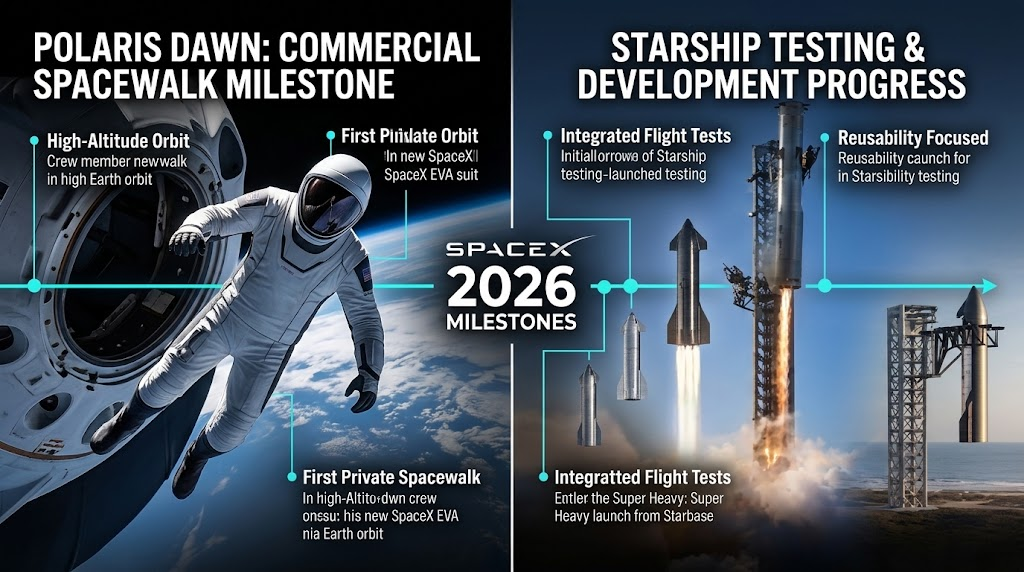
Search interest surrounding SpaceX spiked sharply as the aerospace manufacturer concluded the historic Polaris Dawn human spaceflight mission, achieving the first commercial spacewalk in orbital history. Reaching an apogee of over 1,400 kilometers—the highest altitude reached by humans since the Apollo moon missions—the mission highlighted the rapid evolution of private space infrastructure and modern extravehicular engineering.
Commercial Spacewalk and EVA Suit Engineering
The primary technical milestone of Polaris Dawn was the deployment of SpaceX’s newly engineered Extravehicular Activity (EVA) spacesuits. Unlike traditional bulky NASA spacesuits requiring dedicated airlock chambers, the entire Crew Dragon cabin was depressurized, exposing the four-person crew to the vacuum of low-Earth orbit while relying entirely on umbilical life-support systems.
The operational success of these scalable EVA suits provides critical real-world telemetry for long-duration deep-space architecture. By standardizing spacesuit manufacturing and simplifying mobility joints, SpaceX aims to slash the unit cost of astronaut gear as missions scale toward lunar logistics and future Starship deployments.
Expanding the Orbital Communications Mesh
Beyond extravehicular operations, the crew conducted vital space communication benchmarks:
- Laser-Based Starlink Optical Relays: The Dragon spacecraft established high-throughput optical communications with SpaceX’s Starlink satellite constellation, proving reliable low-latency data transmission without relying on congested ground stations.
- Microgravity Radiation Studies: Flying through the inner belts of the Van Allen radiation zone provided essential biomedical data on human cellular exposure and spaceflight-associated neuro-ocular syndrome.
- Reusable Fleet Turnarounds: The Falcon 9 booster supporting the flight successfully completed another offshore landing, continuing a rapid turnaround cadence across launch complexes.
- Integrated Starship Synergy: Lessons learned from Dragon thermal shielding, life-support pressure envelopes, and avionics redundancy are feeding directly into orbital staging iterations for Starship.
Aerospace Industry Metric:
SpaceX currently handles over 80% of global commercial mass-to-orbit payloads, with Falcon 9 launch cadences exceeding an average of one mission every 2.8 days.
What This Means for the Private Space Economy
Polaris Dawn marks the departure of private human spaceflight from short suborbital tourism flights toward high-altitude, operational orbital utility. As private launch operators prove they can execute complex technical spacewalks and biomedical research autonomously, the landscape of aerospace enterprise is shifting permanently into the commercial sector.
Related Reading: Discover how enterprise engineering adapts to mission-critical infrastructure in our report on enterprise patch deployments and systems administration, or see how automation transforms logistics in our analysis of edge AI in chain retail and inventory management.
TrendSpike Editorial Team
Staff Research & Technical AnalysisIndependent research covering distributed cloud systems, modern enterprise software engineering, and macro-financial policy. Our technical and financial analyses reference primary documentation, official regulatory filings, and benchmark architectures.