Treasury Bills vs High-Yield Savings Accounts (HYSA) in 2026: The State Tax Exemption Math Explained
Comparing 4-week to 26-week T-Bills against High-Yield Savings Accounts in 2026. See the after-tax yield formula, state tax exemptions, and cash-laddering tactics.
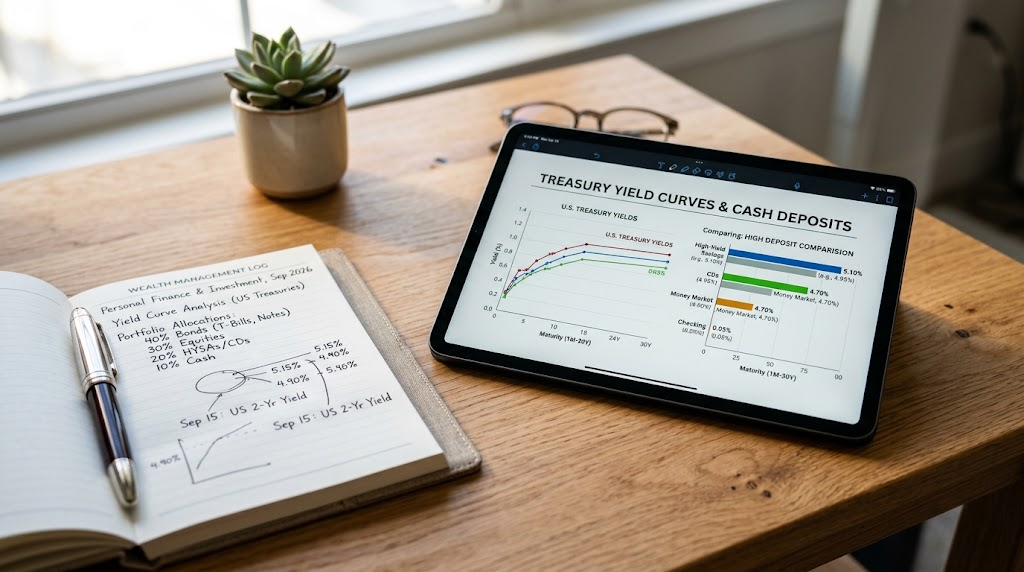
With cash yields remaining competitive through late 2026, savers parking emergency funds or short-term liquidity face a pivotal choice: leave capital in a High-Yield Savings Account (HYSA) or purchase short-dated U.S. Treasury Bills. While headline Annual Percentage Yields (APYs) often appear virtually identical on bank websites, the actual take-home return diverges significantly once state and local taxes are applied.
For investors living in moderate-to-high tax states, the difference between these two instruments is not just a fraction of a percent—it determines whether your cash preserves purchasing power against inflation or loses value after filing with the IRS and state authorities.
The Headline Yield vs. After-Tax Reality
HYSAs and Treasury bills operate under fundamentally distinct regulatory and tax frameworks. The primary edge of U.S. government debt lies in Title 31 of the United States Code: Treasury securities are completely exempt from state and local income taxes.
| Operational Feature | High-Yield Savings Account (HYSA) | Short-Term Treasury Bills (T-Bills) |
|---|---|---|
| Federal Income Tax | Taxable as Ordinary Income (1099-INT) | Taxable as Ordinary Income (1099-B / 1099-INT) |
| State & Local Income Tax | Fully Taxable (0% to 13.3% depending on state) | 100% Exempt Nationwide |
| Underlying Guarantee | FDIC / NCUA insured up to $250,000 per institution | Direct Full Faith & Credit of the U.S. Government |
| Rate Certainty | Variable (Banks can cut APY overnight) | Fixed at auction discount through maturity (4–52 wks) |
| Liquidity Window | Immediate (ACH transfer within 1–2 business days) | Secondary market trade or wait for maturity cycle |
The Breakeven Math: How to Calculate Tax-Equivalent Yield
To determine if an HYSA can compete with a Treasury bill, savers must calculate the Tax-Equivalent Yield (TEY) based on their combined marginal state tax rate:
Equivalent HYSA APY = T-Bill Yield ÷ (1 − State Marginal Tax Rate)
For example, if a 4-week or 13-week T-Bill yields 4.20%, and an investor resides in California (9.3% bracket) or New York (6.85% bracket):
- In California: An HYSA must pay an APY of at least 4.63% just to match the take-home return of a 4.20% T-Bill.
- In New York City (State + City Tax ~10.5%): An HYSA must deliver 4.69% to match the 4.20% sovereign instrument.
- In Zero-Tax States (Texas, Florida, Washington): The tax advantage is zero; cash allocation simply defaults to whichever vehicle offers the higher nominal baseline APY.
How to Structure a 4-Week T-Bill Ladder for Maximum Liquidity
The primary objection to Treasury bills is locked duration. Unlike an HYSA, where cash can be withdrawn on demand, T-Bills mature over fixed increments (4 weeks, 8 weeks, 13 weeks, 17 weeks, 26 weeks, or 52 weeks).
- Divide Capital into 4 Equal Tranches: Split your short-term cash reserves into four identical buckets (e.g., $5,000 each across a $20,000 allocation).
- Deploy Staggered Weekly Auctions: Buy a 4-week T-Bill during week 1, another during week 2, week 3, and week 4 via TreasuryDirect or an institutional brokerage (Schwab, Fidelity, Vanguard).
- Enable Auto-Reinvestment: With recurring roll-over active, one tranche matures every seven days. If cash is required, cancel the upcoming reinvestment and receive the full par value directly to your checking account without secondary liquidation penalties.
Related Personal Finance & Planning Coverage
- → IRS 2026 401(k) Contribution Limits and Super Catch-Up Rules: Complete Bracket & Tax Savings Guide
- → UK Redundancy Pay Calculator 2026: The £30,000 Tax-Free Rule, Statutory Caps, and Rights Explained
- → Federal Student Loan Forbearance and Autopay Reductions: Complete Q4 2026 Borrower Guide
- → Explore Full TrendSpike Financial Archive →
TrendSpike Editorial Team
Staff Research & Technical AnalysisIndependent research covering distributed cloud systems, modern enterprise software engineering, and macro-financial policy. Our technical and financial analyses reference primary documentation, official regulatory filings, and benchmark architectures.