Agency MBS Negative Convexity and Institutional Housing Finance: Prepayment Lock-In Mechanics, ASC 606 Rate-Buydown Accounting, and SOMA Balance-Sheet Runoff
A quantitative fixed-income and corporate finance analysis of the U.S. agency mortgage-backed securities (MBS) market, examining conditional prepayment rate (CPR) lock-in, Option-Adjusted Spread (OAS) duration extension, FASB ASC 606 homebuilder rate-buydown accounting, and Single-Family Rental (SFR) securitization.
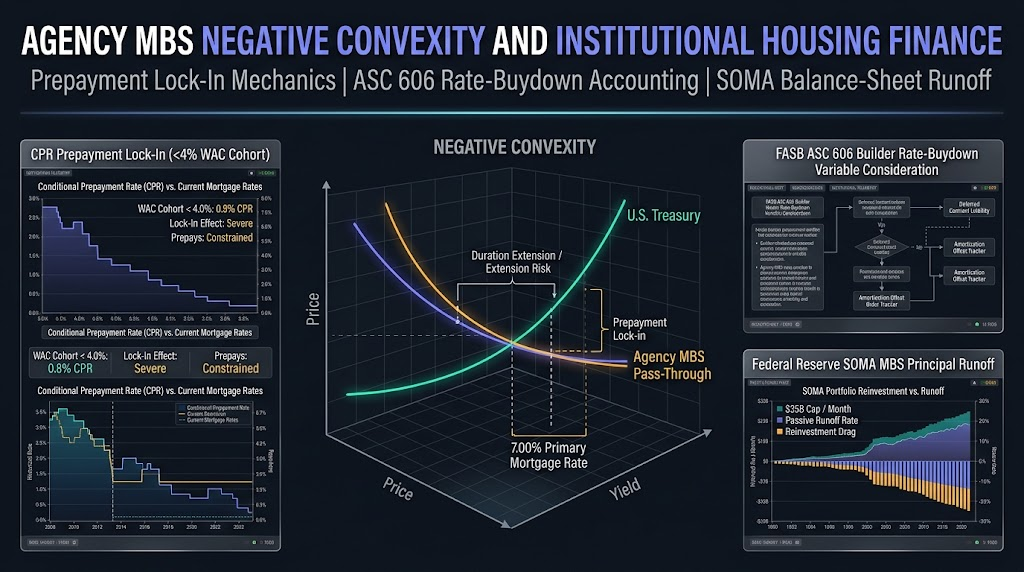
The structural repricing of long-duration sovereign debt yields has fundamentally altered the microstructure of the United States residential credit and Agency Mortgage-Backed Securities (MBS) markets. With primary 30-year fixed-rate conforming mortgage commitments entrenched significantly above the weighted-average coupon (WAC) of the outstanding agency mortgage universe, institutional fixed-income portfolios are confronting severe duration extension, empirical lock-in friction, and widened Option-Adjusted Spreads (OAS). Simultaneously, publicly traded homebuilders and institutional Single-Family Rental (SFR) securitization sponsors are re-engineering capital deployment—utilizing captive mortgage rate buydowns governed by FASB ASC 606 variable consideration rules and assumable Government National Mortgage Association (GNMA) debt structures to clear standing inventory.
1. Agency MBS Microstructure: Negative Convexity, Duration Extension, and the Prepayment Lock-In Effect
In fixed-income portfolio management, pass-through Agency Mortgage-Backed Securities—guaranteed by Fannie Mae (FNMA), Freddie Mac (FHLMC), and Ginnie Mae (GNMA)—exhibit pronounced negative convexity due to the borrower's embedded, penalty-free call option to prepay principal at par. When prevailing primary mortgage rates fall below the pool's Weighted-Average Coupon (WAC), refinancing accelerates, compressing effective duration; conversely, when benchmark 10-year Treasury yields and primary mortgage rates rise sharply above historical WAC cohorts, refinancing incentives collapse and borrowers become economically locked into legacy sub-4% debt obligations.
As tracked in quarterly residential mortgage statistics published by the Federal Housing Finance Agency (FHFA) National Mortgage Database and the Federal Reserve Bank of New York System Open Market Account (SOMA), this coupon dispersion creates an acute bifurcated market:
- Collapse of Conditional Prepayment Rates (CPR): Across deep-out-of-the-money agency pools (30-year Uniform Mortgage-Backed Securities [UMBS] carrying 2.0% to 3.5% coupons), voluntary refinancing turnover has fallen to zero, leaving baseline housing turnover (death, divorce, relocation) at historical lows of 4% to 6% annualized CPR.
- Extension Risk in Bank Held-to-Maturity (HTM) Portfolios: As prepayment speeds decelerate toward contractual scheduled amortization, the effective duration of low-coupon MBS extends from ~4.5 years to over 8.0 years—magnifying unrealized mark-to-market capital losses across commercial bank balance sheets regulated under FASB ASC Topic 320 (Investments—Debt Securities).
- Federal Reserve SOMA Passive Runoff Cap Friction: Because the Federal Reserve's quantitative tightening (QT) program relies on passive principal paydowns to shrink its multi-trillion-dollar Agency MBS holdings, depressed CPR speeds keep monthly MBS redemptions consistently below the FOMC's statutory runoff cap, prolonging central bank balance-sheet normalization.
2. Quantitative Prepayment & Option-Adjusted Spread (OAS) Mathematics
Institutional MBS trading desks and fixed-income risk engines model pool cash flows by converting Monthly Mortality (SMM) into annualized Conditional Prepayment Rates (CPR) and pricing the embedded borrower call option via Monte Carlo interest-rate path simulations:
$$\text{SMM}_t = \frac{\text{Unscheduled Principal Prepayment}_t}{\text{Beginning Pool Principal Balance}_t - \text{Scheduled Principal Amortization}_t}$$ $$\text{CPR}_t = 1 - \left(1 - \text{SMM}_t\right)^{12}$$
$$P_{\text{MBS\_Market}} = \frac{1}{K} \sum_{k=1}^{K} \sum_{t=1}^{360} \frac{CF_{t}^{(k)}\left(r_t^{(k)}, \, \text{CPR}_t^{(k)}\right)}{\prod_{s=1}^{t} \left(1 + r_{s}^{(k)} + \text{OAS}\right)}$$ Where $K$ represents simulated interest-rate paths, $r_s^{(k)}$ is the short-rate along path $k$, and $\text{OAS}$ is the constant spread compensating investors for model and liquidity risk after stripping out the embedded prepayment option cost ($Z\text{-Spread} = \text{OAS} + \text{Option Cost}$).
3. Corporate Homebuilder Balance Sheets: Captive Rate Buydowns Under FASB ASC 606
While the resale housing market experiences volume paralysis due to existing-homeowner rate lock-in, large publicly traded homebuilders (such as Lennar Corporation and D.R. Horton) have captured disproportionate transaction share by deploying their wholly owned financial services subsidiaries to offer permanent forward mortgage rate buydowns (reducing borrower note rates by 100 to 150 basis points below prevailing Freddie Mac Primary Mortgage Market Survey [PMMS] benchmarks).
Rather than cutting the headline contract sales price of a newly constructed home—which would impair comparable appraisal values across an entire master-planned subdivision—builders purchase bulk forward mortgage commitments and pay upfront discount points on behalf of the buyer. Under FASB Accounting Standards Codification (ASC) Topic 606 (Revenue from Contracts with Customers — Consideration Payable to a Customer, ASC 606-10-32-25), these financing incentives require strict top-line accounting treatment:
- Direct Reduction of Transaction Price (Variable Consideration): Upfront capital expended by a homebuilder's parent or captive mortgage subsidiary to buy down a buyer's permanent interest rate below market does not represent a separate selling or marketing expense (OpEx). Under ASC 606, cash or credit incentives paid to or on behalf of a customer must be recognized as a direct reduction of homebuilding revenue upon title closing—compressing reported gross margin while preserving inventory turnover velocity.
- Forward Commitment Derivative Hedge Accounting (ASC 815): When a captive builder mortgage unit locks in a bulk $500 million forward delivery commitment in the To-Be-Announced (TBA) Agency MBS market to hedge rate-buydown exposure during construction, mark-to-market fluctuations on the TBA forward contract are accounted for as free-standing derivatives under FASB ASC Topic 815 until individual loans close and are delivered into agency pools.
4. Comparative Financing & Securitization Structures in High-Rate Regimes
Institutional real estate operators, corporate builders, and fixed-income asset managers utilize four distinct structural mechanisms to clear residential real estate transactions under elevated benchmark yields:
| Financing / Securitization Structure | Primary Statutory / Agency Authority | Capital Market & Margin Mechanics | GAAP / MBS Investor Impact |
|---|---|---|---|
| Permanent Builder Rate Buydown | FNMA / FHLMC Seller-Funded Interested Party Contributions (IPC) | Builder pays 4–6 upfront discount points into TBA forward commitment | ASC 606 revenue reduction; compresses builder gross margin by 300–500 bps |
| GNMA Assumable Mortgage Transfer | 24 CFR § 203.258 (FHA) & 38 U.S.C. § 3714 (VA Loan Assumptions) | Buyer assumes seller's legacy 2.5%–3.5% note; bridges equity gap via 2nd lien | Suppresses GNMA pool CPR speeds; extends MBS investor duration |
| Build-to-Rent (BTR) / SFR Securitization | Rule 144A Private-Label Single-Family Rental (SFR) CMBS / ABS | Institutional PE acquires entire builder subdivisions at bulk discount | Financed via 5–10 yr fixed SOFR-benchmarked commercial mortgage tranches |
| Home Equity Investment (HEI) / Shared Appreciation | Non-Debt Forward Equity Option / Rated HEI Securitizations | Homeowner monetizes trapped equity without refinancing legacy 1st lien | Accounted for at Fair Value under ASC 825; zero monthly coupon cash flow |
5. Assumable Government-Insured Debt (GNMA) & Build-to-Rent (BTR) Institutional Capital Flows
Outside of new-home construction, institutional financial technology platforms and private credit funds are targeting two structural arbitrage opportunities created by the 300+ basis-point spread between outstanding mortgage WACs and current market origination rates:
- Statutory Assumability in Ginnie Mae (GNMA) Pools: Whereas conventional conforming mortgages securitized in Fannie Mae and Freddie Mac UMBS pools contain enforceable due-on-sale clauses (under the Garn-St Germain Depository Institutions Act of 1982, 12 U.S.C. § 1701j-3) requiring full payoff upon property transfer, mortgages insured by the Federal Housing Administration (FHA) and Department of Veterans Affairs (VA) backing Ginnie Mae MBS are statutorily assumable by credit-qualified purchasers. Specialized settlement platforms originate subordinate second-lien bridge financing to cover the seller's accumulated home equity, allowing the buyer to preserve the legacy 2.75%–3.50% first-lien note—while simultaneously depriving GNMA bondholders of expected housing-turnover par prepayments.
- Institutional Build-to-Rent (BTR) Forward Takeouts: Rather than relying exclusively on retail mortgage originations, public homebuilders increasingly execute forward bulk sale agreements with institutional private-equity Single-Family Rental (SFR) REITs. Under these forward takeout structures, the institutional sponsor funds construction draws and securitizes the stabilized rental cash flows in the Rule 144A asset-backed securities (ABS) market, insulating builder inventory turns from retail mortgage rate volatility.
Primary Regulatory, Central Bank & Accounting References
- 1. Federal Housing Finance Agency (FHFA): National Mortgage Database (NMDB) — Outstanding Residential Mortgage WAC Distribution & Prepayment Telemetry.
- 2. Federal Reserve Bank of New York: System Open Market Account (SOMA) Agency Mortgage-Backed Securities Holdings & Principal Paydown Schedules.
- 3. Financial Accounting Standards Board (FASB): Accounting Standards Codification (ASC) Subtopic 606-10-32 (Consideration Payable to a Customer), Topic 320 (Investments—Debt Securities), and Topic 815 (Derivatives and Hedging).
- 4. United States Code (12 U.S.C. § 1701j-3 & 38 U.S.C. § 3714): Garn-St Germain Depository Institutions Act Due-on-Sale Preemption & Statutory FHA/VA Mortgage Assumption Rules.
- 5. Securities Industry and Financial Markets Association (SIFMA): U.S. Agency MBS Issuance, TBA Trading Volume, and Securitization Standards.
Related Institutional Finance & Capital Markets Research
- → Basel III Endgame (Basel 3.1): Risk-Weighted Assets (RWA), Output Floors, and Capital Adequacy Mechanics
- → IRC Section 163(j) Business Interest Limitation: EBIT vs. EBITDA ATI Mechanics and Corporate Debt Modeling
- → European Central Bank (ECB) Monetary Policy Transmission: Deposit Facility Rate Corridors and TLTRO III Liquidity Absorption
TrendSpike Editorial Team
Staff Research & Technical AnalysisIndependent research covering distributed cloud systems, modern enterprise software engineering, and macro-financial policy. Our technical and financial analyses reference primary documentation, official regulatory filings, and benchmark architectures.