Municipal Utility Concession Finance and Subterranean Pipeline Telemetry: IFRIC 12 Accounting, Structural Leakage Index (ILI) Mechanics, and CapEx Amortization
An institutional infrastructure finance and civil telemetry analysis of European municipal water concession networks, examining IFRIC 12 Service Concession Arrangements, Infrastructure Leakage Index (ILI) hydraulics, acoustic cross-correlation signal processing, and utility CapEx financing.
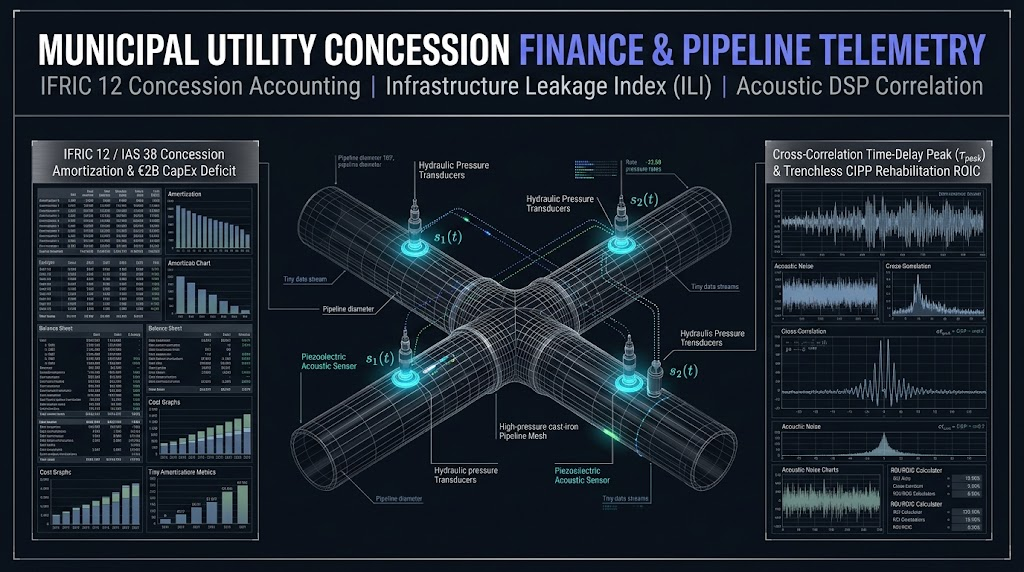
Across Western Europe, subterranean potable water distribution and wastewater sanitation networks confront a severe structural capital expenditure (CapEx) renewal deficit. In France—where approximately 1,000,000 kilometers of potable distribution mains and 380,000 kilometers of sanitation conduits form one of the world's most expansive hydraulic grids—audits compiled by the national water observatory (SISPEA — Système d'Information sur les Services Publics d'Eau et d'Assainissement) indicate an average volumetric network efficiency hovering near 80%, resulting in nearly one billion cubic meters of Non-Revenue Water (NRW) losses annually. For institutional infrastructure funds, municipal bond underwriters, and utility concession operators (such as Veolia and Saur), addressing an estimated €2 billion annual CapEx shortfall against a sub-0.7% physical pipe replacement rate requires rigorous alignment across IFRIC 12 Service Concession Accounting, EU Directive 2020/2184 Structural Leakage Index (ILI) mandates, and real-time acoustic cross-correlation telemetry.
1. Hydraulic Asset Decay & The Infrastructure Leakage Index (ILI) Framework
The physical deterioration of post-war European hydraulic networks—constructed predominantly from grey cast iron, asbestos cement, ductile iron, and first-generation unplasticized polyvinyl chloride (uPVC) during the 1950–1980 urbanization cycle—is governed by soil mechanics, cyclic water-hammer pressure transients, and elastomer joint degradation. At an observed physical replacement velocity of 0.6% to 0.7% per annum, the implied asset amortization cycle extends to 140–165 years, exceeding the 50-to-80-year engineered service life of the underlying metallic and polymer conduits by more than two-fold.
Under Article 4 of the recast European Union Drinking Water Directive (Directive (EU) 2020/2184) and French Plan Eau regulatory decrees enforced via regional water agencies (Agences de l'Eau), public authorities (collectivités territoriales) and private concessionaires must quantify physical distribution losses using standardized hydraulic metrics rather than simple percentage-of-input ratios. Institutional engineering audits evaluate network integrity via the Linear Leakage Index (LLI) and the International Water Association (IWA) Infrastructure Leakage Index (ILI):
$$\text{UARL} = \left( 18 \cdot L_m + 0.80 \cdot N_c + 25 \cdot L_p \right) \cdot P_{\text{avg}}$$ $$\text{ILI} = \frac{\text{CARL (Current Annual Real Losses)}}{\text{UARL}}$$ Where $L_m$ is mains length (km), $N_c$ is number of service connections, $L_p$ is private underground pipe length (km), and $P_{\text{avg}}$ is average operating pressure in meters of head.
$$\eta_{\text{SISPEA}} = \frac{V_{\text{billed\_metered}} + V_{\text{service\_authorized}} + V_{\text{exported}}}{V_{\text{produced}} + V_{\text{imported}}} \ge \tau_{\text{threshold}} \quad \left(\text{where } \tau_{\text{threshold}} = 85\% \text{ or } \text{LLI} \le \text{LLI}_{\text{ref}}\right)$$
Under French environmental tax law (Code de l'environnement), utilities failing to meet the statutory efficiency threshold ($\eta_{\text{SISPEA}} \ge 85\%$ in urban zones or $65\% + 0.2 \times \text{Linear Consumption Index}$ in rural communes) or failing to maintain digitized geographic information system (GIS) asset inventories face punitive escalations in the performance-modulated water abstraction fee (redevance pour performance des réseaux d'eau potable).
2. Concession Financial Reporting: IFRIC 12 Service Concession Arrangements & IAS 38
In France and across the European Union, municipal water infrastructure is predominantly owned by public local authorities (syndicats intercommunaux or métropoles) and operated by private corporate utilities under long-term Public-Private Partnerships (PPPs) or delegated public service contracts (Délégation de Service Public — DSP, structured as affermage lease-operations or full concessions).
Because the underlying subterranean pipe network reverts to the municipality at the conclusion of the concession term, private utility operators cannot recognize the physical pipelines as Property, Plant, and Equipment (PP&E) under IAS 16. Instead, consolidated financial reporting is governed strictly by IFRS Interpretations Committee Interpretation 12 (IFRIC 12 — Service Concession Arrangements):
- The Intangible Asset Model (IFRIC 12.17 / IAS 38): In standard French affermage contracts where the private operator receives a contractual right to charge end-user consumers a volumetric water tariff ($€/\text{m}^3$), the operator bears demand risk. Consequently, all capital expenditures (CapEx) incurred by the operator to rehabilitate pipelines, deploy smart acoustic telemetry, or construct treatment plants are capitalized as an Intangible Concession Asset under IAS 38 and amortized ratably over the strictly bounded remaining legal duration of the DSP contract—never over the 80-year physical life of the pipe.
- The Financial Asset Model (IFRIC 12.16 / IFRS 9): When the municipal grantor guarantees an unconditional minimum availability payment regardless of consumer water volume consumption, the operator recognizes a financial receivable under IFRS 9 measured at amortized cost using the effective interest method.
- Contractual Renewal & Contractual Maintenance Provisions (IAS 37): Because concessionaires are contractually obligated to return the hydraulic network in a specified state of operational efficiency at contract expiry, projected future pipeline rehabilitation obligations must be accrued systematically as IAS 37 Contractual Maintenance Provisions across the concession lifecycle.
3. Acoustic Cross-Correlation Telemetry & Digital Twin Predictive Maintenance
Because open-cut urban street excavation costs between $€400\text{ and }€1,200\text{ per linear meter}$—and because IFRIC 12 requires rapid amortization of CapEx prior to concession expiry—utility operators deploy fixed Internet of Things (IoT) vibro-acoustic sensor arrays and hydraulic digital twins to target rehabilitation CapEx strictly toward high-probability rupture segments.
When pressurized water escapes through a circumferential crack or corroded joint saddle at pressure $P$, turbulent cavitation generates a broadband acoustic wave that propagates bidirectionally along the pipe wall and water column at a material-dependent acoustic phase velocity $c$ (ranging from $\sim 450\text{ m/s}$ in viscoelastic PVC pipes to $\sim 1,250\text{ m/s}$ in rigid cast-iron mains). Piezoelectric accelerometers or hydrophones clamped at two access valves separated by distance $D$ sample the time-series signals $s_1(t)$ and $s_2(t)$ and compute the Cross-Correlation Function ($R_{s_1 s_2}(\tau)$) via Fast Fourier Transform (FFT) spectral density:
$$R_{s_1 s_2}(\tau) = \lim_{T \to \infty} \frac{1}{T} \int_{-T/2}^{T/2} s_1(t) \cdot s_2(t + \tau) \, dt = \mathcal{F}^{-1}\left\{ \Psi(\omega) \cdot G_{s_1 s_2}(\omega) \right\}$$
$$d_1 = \frac{D - c \cdot \tau_{\text{peak}}}{2} \quad \text{where } \tau_{\text{peak}} = \arg\max_{\tau} R_{s_1 s_2}(\tau)$$
By combining acoustic time-delay-of-arrival ($\tau_{\text{peak}}$) localization with Synthetic Aperture Radar (SAR) satellite soil-moisture interferometry and Weibull survival hazard modeling, municipal digital twins isolate subterranean leaks within $\pm 0.5\text{ meters}$ prior to surface pavement collapse.
4. Comparative Civil Rehabilitation Engineering & Capital Economics
Infrastructure asset managers evaluate physical pipeline remediation methodologies across five civil engineering and financial accounting dimensions:
| Engineering & Financial Metric | Traditional Open-Cut Trench Replacement | Trenchless Cured-in-Place Pipe (CIPP) Structural Relining | Acoustic IoT + Dynamic Pressure Management (PMA) |
|---|---|---|---|
| Direct CapEx Outlay ($€ / \text{Meter}$) | High ($€400\text{–}€1,200/\text{m}$; 70% consumed by asphalt & soil excavation) | Moderate ($€180\text{–}€450/\text{m}$; inserted via existing access chambers) | Low ($€15\text{–}€45/\text{m}$ equivalent network sensor & PRV deployment) |
| Structural Design Life Extension | 75–100 Years (New PE100-RC or cement-lined ductile iron main) | 50+ Years (Class IV fully structural thermoset resin composite liner) | Reduces burst frequency by 35%–50% via transient pressure damping |
| IFRIC 12 / IAS 38 Accounting Treatment | Capitalized into Concession Intangible (or municipal M57 public PP&E) | Capitalized as structural betterment or charged to IAS 37 renewal reserve | Short-cycle IT/IoT intangible amortization (5–10 years) + SaaS OpEx |
| Scope 1–3 Carbon Footprint | Severe (Heavy diesel excavation, virgin aggregate haulage & asphalt) | 60%–80% lower $\text{CO}_2\text{e}$ emissions vs. open-cut excavation | Immediately lowers pumping kilowatt-hour ($\text{kWh}/\text{m}^3$) energy intensity |
| Payback Period on NRW Savings | 18–35 Years (Requires long-tenor EIB or Caisse des Dépôts debt) | 8–15 Years (Accelerated in dense urban districts) | 1.5–3.5 Years via avoided chemical treatment, pumping & tax penalties |
5. Institutional Green Bond Financing, EIB Credit Lines & EU Taxonomy Alignment
Bridging a multi-billion-euro annual hydraulic infrastructure deficit across fragmented municipal authorities requires long-duration institutional debt structuring. Under the European Union Taxonomy for Sustainable Activities (Regulation (EU) 2020/852), capital expenditures dedicated to constructing, extending, and renewing water collection, treatment, and supply systems qualify as environmentally sustainable ("Green Bond Eligible") only if the project achieves a verifiable reduction in network leakage—specifically reducing the Infrastructure Leakage Index ($\text{ILI}$) below 1.5 (or achieving a $20\%+$ reduction in net energy consumption per cubic meter of billed water supply).
To finance these long-lived capital assets without triggering municipal debt-ceiling breaches, public authorities and corporate utilities rely on two primary institutional funding conduits: long-tenor green bond issuances under the European Green Bond Standard (EuGB) and sovereign co-financing facilities structured by the European Investment Bank (EIB) Water Sector Lending Mandate alongside France's Banque des Territoires (Caisse des Dépôts) *Aqua Prêt* 25-to-40-year amortized loan facilities—matching debt service schedules directly to the physical multi-decade lifecycle of rehabilitated subterranean infrastructure.
Primary Regulatory, Accounting & Engineering References
- 1. Official Journal of the European Union (EUR-Lex): Directive (EU) 2020/2184 on the Quality of Water Intended for Human Consumption (Article 4 — Structural Leakage Assessment & Infrastructure Leakage Index Mandates).
- 2. Observatoire National des Services d'Eau et d'Assainissement (SISPEA / OFB): French National Water & Sanitation Performance Indicators — Volumetric Network Efficiency & Linear Loss Telemetry.
- 3. International Financial Reporting Standards (IFRS Foundation): IFRIC 12 — Service Concession Arrangements (Intangible Asset vs. Financial Asset Concession Accounting) & IAS 38 (Intangible Assets).
- 4. European Investment Bank (EIB): EIB Water Sector Lending Policy & EU Taxonomy Technical Screening Criteria for Sustainable Water Infrastructure.
- 5. Official Journal of the European Union (EUR-Lex): Regulation (EU) 2020/852 (Taxonomy Regulation) — Climate Mitigation & Water Resource Protection Thresholds.
Related Infrastructure Finance & Industrial Research
- → Industrial Plant Restructuring and Capital Reallocation: IAS 36 Asset Impairment, IAS 37 Severance Provisions, and Brownfield Defense Conversion
- → Sovereign Wealth Asset Allocation and NBIM Benchmark Mechanics: Fiscal Rule Sterilization, Tracking Error Limits, and Fixed-Income Duration Rebalancing
- → European Central Bank (ECB) Monetary Policy Transmission: Deposit Facility Rate Corridors, TLTRO III Liquidity Absorption, and the TPI
TrendSpike Editorial Team
Staff Research & Technical AnalysisIndependent research covering distributed cloud systems, modern enterprise software engineering, and macro-financial policy. Our technical and financial analyses reference primary documentation, official regulatory filings, and benchmark architectures.