Sovereign Wealth Asset Allocation and NBIM Benchmark Mechanics: Fiscal Rule Sterilization, Tracking Error Limits, and Fixed-Income Duration Rebalancing
An institutional quantitative portfolio analysis of Norway's Government Pension Fund Global (GPFG) and Norges Bank Investment Management (NBIM), examining the 3% fiscal extraction rule, FTSE Global All Cap factor weighting, ex-ante tracking error constraints, and fixed-income MBS reallocation.
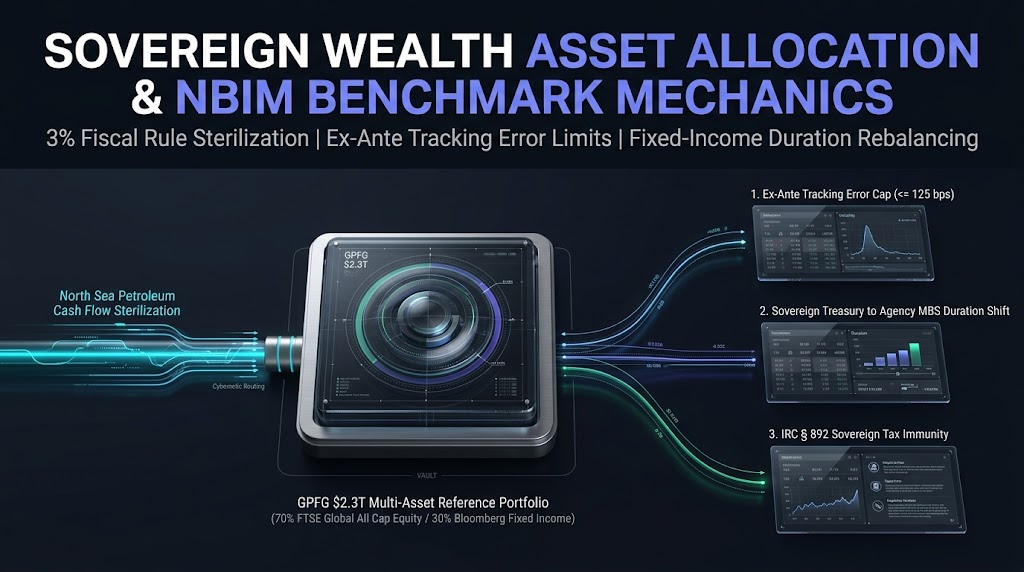
Across global public equity and sovereign debt exchanges, Norway’s Government Pension Fund Global (GPFG)—managed operationally by Norges Bank Investment Management (NBIM) under a formal mandate from the Norwegian Ministry of Finance—functions as the world's largest single-owner institutional reference portfolio. Commanding more than $2.3 trillion in assets under management (AUM) and holding an average ownership stake of approximately 1.5% across more than 7,200 publicly listed corporations worldwide, the fund's rebalancing mechanics directly influence global equity liquidity, semiconductor supply-chain capitalization, and G10 sovereign yield curves. Evaluating NBIM's institutional architecture requires analyzing its macroeconomic sterilization mandate, the 3% fiscal spending rule (Handlingsregelen), ex-ante tracking error constraints, and cross-border sovereign tax immunity under Internal Revenue Code (IRC) Section 892.
1. Macroeconomic Sterilization Mechanics: Curing "Dutch Disease" & The 3% Fiscal Rule
Established legislatively under the Government Pension Fund Act of 1990, the GPFG was engineered to solve a classic open-economy macroeconomic pathology known as Dutch Disease: when a small, trade-exposed domestic economy experiences massive foreign-currency windfalls from non-renewable resource extraction (North Sea crude oil and natural gas petroleum taxation, plus direct state ownership via Equinor and Petoro), converting those revenues directly into domestic currency appreciates the real exchange rate, inflates domestic non-tradable wages, and crowds out export-oriented industrial manufacturing.
As codified by the Norwegian Ministry of Finance Management Mandate for the Government Pension Fund Global, the sovereign architecture neutralizes domestic inflationary transmission through two rigid statutory mechanisms:
- 100% External Capital Deployment Mandate: The net cash flow from petroleum activities—comprising specialized 78% marginal petroleum extraction taxes, carbon levies, and SDFI (State's Direct Financial Interest) operating dividends—is transferred directly to the GPFG and invested exclusively in financial assets, sovereign debt, and unlisted infrastructure located outside Norway. Norges Bank executes offsetting foreign exchange sterilization in the institutional spot market to convert domestic tax receipts into USD, EUR, GBP, and JPY investment capital.
- The Statutory Fiscal Rule (Handlingsregelen): To insulate the annual national government budget from oil-price volatility and preserve intergenerational principal parity, parliamentary fiscal withdrawals from the GPFG to cover the non-oil structural budget deficit are capped over the economic cycle at the fund's expected long-term real rate of return—formally calibrated downward from 4.0% to 3.0% per annum of beginning-of-year fund capital.
2. Quantitative Portfolio Construction: Reference Index Weighting, Tracking Error & Information Ratio
Unlike discretionary endowment models or opaque sovereign private-equity vehicles, NBIM operates under a tightly constrained, transparent Reference Index Architecture. The strategic benchmark portfolio prescribed by the Ministry of Finance establishes a baseline 70% Strategic Equity / 30% Fixed-Income allocation split (with unlisted real estate and unlisted renewable energy infrastructure carved out of the reference portfolio up to maximum statutory sub-caps of 7% and 2%, respectively).
The equity benchmark is constructed atop the FTSE Global All Cap Index, utilizing market-capitalization weights adjusted by regional macroeconomic scaling factors, while the fixed-income benchmark tracks the Bloomberg Barclays Global Aggregate Index (split 70% into GDP-weighted sovereign government bonds and 30% into investment-grade corporate credit). NBIM's active management authority is strictly bounded by a statutory Maximum Ex-Ante Relative Volatility (Tracking Error) Ceiling of 125 basis points (1.25%):
$$S_t = r_{\text{real}} \cdot \mathbb{E}\left[ V_{\text{GPFG}, t-1} \right] \quad \text{where } r_{\text{real}} = 0.030 \text{ (3.0\% Expected Real Return)}$$
$$\text{TE}_{\text{ex-ante}} = \sqrt{ \left(\mathbf{w}_p - \mathbf{w}_b\right)^{\top} \mathbf{\Sigma}_{\text{cov}} \left(\mathbf{w}_p - \mathbf{w}_b\right) } \le 0.0125 \text{ (125 bps Statutory Cap)}$$ $$\text{IR} = \frac{\mathbb{E}\left[ R_p - R_b \right]}{\text{TE}_{\text{realized}}}$$ Where $\mathbf{w}_p$ and $\mathbf{w}_b$ are the portfolio and FTSE/Bloomberg benchmark weight vectors, and $\mathbf{\Sigma}_{\text{cov}}$ is the multi-asset factor covariance matrix.
Because free-float market capitalization weighting governs the FTSE Global All Cap equity sleeve, rapid valuation expansion across mega-cap artificial intelligence and semiconductor fabrication leaders—specifically NVIDIA, Apple, Microsoft, Alphabet, Amazon, Taiwan Semiconductor Manufacturing Company (TSMC), and ASML Holding—mechanically concentrates the fund's absolute dollar exposure into global compute infrastructure. To prevent pro-cyclical drift when equity markets surge past the 70% threshold, the Ministry of Finance mandate enforces an automatic Rebalancing Rule triggered whenever the equity share deviates by more than ±4.0 percentage points (below 66% or above 74%) at month-end.
3. Comparative Sovereign Asset Allocation: NBIM Reference Model vs. Endowment & Strategic Development Funds
Institutional asset allocators and central bank reserve managers benchmark the GPFG's transparent index-plus model against alternative sovereign wealth archetypes codified under the International Forum of Sovereign Wealth Funds (IFSWF) Santiago Principles:
| Portfolio Governance Parameter | NBIM / GPFG Reference Index Model | Endowment / Private-Markets SWF Model | Central Bank FX Reserve Tranche |
|---|---|---|---|
| Strategic Asset Mix | 70% Public Equities / ~27% Fixed Income / ~3% Real Assets | 35%–50% Illiquid PE, Venture Capital, Direct Buyouts & Infra | 85%–100% Short-Duration G10 Sovereign Bills, Notes & Gold |
| Active Risk / Tracking Error Limit | Strict 125 bps ex-ante tracking error cap vs. FTSE/Bloomberg | Unconstrained absolute return / CPI + spread hurdle rate | Zero equity risk; strict VaR and liquidity duration caps |
| Management Cost & Fee Drag | Ultra-low (~4 to 6 bps of AUM; predominantly internal execution) | High (150–250 bps external GP "2-and-20" management & carry fees) | Minimal (~1 to 2 bps custodial and primary dealer execution) |
| Liquidity & Rebalancing Velocity | T+1 / T+2 exchange-traded liquidity across 7,200+ global equities | 7–12 year lock-ups; subject to secondary NAV discounts | Immediate intraday repo & FX intervention liquidity |
| U.S. Tax Statutory Treatment | IRC § 892 exemption on portfolio dividends & interest (<50% control) | Exposed to § 892(a)(2) "Commercial Activity" & FIRPTA § 897 taint | IRC § 895 central bank immunity on U.S. Treasury obligations |
4. Fixed-Income Duration Rebalancing: Trimming Sovereign Debt for Agency MBS & Renewable Infrastructure
Within its 30% fixed-income sleeve, NBIM has historically maintained a structural overweight in U.S. Treasury notes and bonds, European sovereign debt, and Japanese Government Bonds (JGBs) to serve as a deflationary liquidity ballast during global equity drawdowns. However, when sovereign debt-to-GDP trajectories expand concurrently with elevated core inflation, the stock-bond return correlation ($\rho_{\text{equity, bond}}$) flips from negative to positive—eroding the diversification benefit of nominal long-duration government bonds.
To optimize risk-adjusted yield capture within its 125-basis-point tracking error budget, NBIM's fixed-income desk executes strategic cross-sector reallocations—trimming up to $80 billion in low-spread benchmark sovereign Treasury holdings to deploy capital into two higher-yielding credit and real-asset segments:
- Agency Mortgage-Backed Securities (MBS) Spread Capture: By rotating out of nominal U.S. Treasuries into Ginnie Mae (GNMA), Fannie Mae (FNMA), and Freddie Mac (FHLMC) pass-through MBS pools trading at elevated Option-Adjusted Spreads (OAS), the fund captures an incremental 45 to 75 basis points of yield backed by explicit or implicit U.S. sovereign credit guarantees, particularly across low-prepayment coupon cohorts.
- Unlisted Renewable Energy Infrastructure Joint Ventures: Utilizing its statutory 2% renewable infrastructure allocation carve-out, NBIM acquires direct 49% minority equity stakes in utility-scale offshore wind farms, solar transmission grids, and power-purchase-agreement (PPA) assets across Western Europe and North America alongside industrial energy operators—generating inflation-indexed cash flows uncorrelated with public SaaS and semiconductor equity multiples.
5. Proxy Voting Governance & Cross-Border Sovereign Tax Immunity Under IRC Section 892
Holding 1.5% of global listed equity prevents NBIM from simply exiting underperforming governance regimes ("Wall Street Walk"); instead, the fund exercises active proxy voting across more than 115,000 shareholder ballot proposals annually. NBIM publishes advance voting intentions five days prior to corporate annual general meetings (AGMs), systematically opposing excessive CEO equity dilution that lacks multi-year Return on Invested Capital (ROIC) performance vesting hurdles, enforcing board-level algorithmic AI risk oversight, and requiring audited Scope 1, Scope 2, and material Scope 3 greenhouse gas disclosures aligned with the IFRS International Sustainability Standards Board (ISSB) Standard S2.
Crucially, the fund's ability to compound U.S. technology and fixed-income returns without cross-border withholding tax leakage depends on strict adherence to 26 U.S.C. § 892 (Income of Foreign Governments and of International Organizations). Under IRC § 892(a)(1), dividend and interest income earned by a foreign sovereign integral part or controlled entity from non-controlling portfolio investments in U.S. stocks and securities is statutorily exempt from the standard 30% U.S. nonresident withholding tax (IRC § 1442). However, under IRC § 892(a)(2)(A), this exemption is immediately revoked on income derived from the conduct of any "commercial activity" anywhere in the world or received from a "controlled commercial entity" (where the sovereign holds $\ge 50\%$ by vote or value)—explaining why NBIM caps its corporate ownership stakes well below controlling thresholds and structures unlisted real estate and infrastructure investments through carefully ring-fenced joint-venture vehicles.
Primary Sovereign, Statutory & Institutional References
- 1. Norges Bank Investment Management (NBIM): Government Pension Fund Global Annual Report, Investment Strategy & Benchmark Holdings Disclosures.
- 2. Norwegian Ministry of Finance (Det Kongelige Finansdepartement): Management Mandate for the Government Pension Fund Global — Reference Index Rules & 125 bps Tracking Error Limit.
- 3. United States Code (26 U.S.C. § 892 & § 895): Internal Revenue Code Section 892 — Income of Foreign Governments and Sovereign Wealth Funds (Exemption & Commercial Activity Exceptions).
- 4. International Forum of Sovereign Wealth Funds (IFSWF) & IMF: Generally Accepted Principles and Practices (GAPP) — The Santiago Principles for Sovereign Wealth Fund Governance.
- 5. IFRS Foundation (International Sustainability Standards Board — ISSB): IFRS S2 — Climate-related Disclosures & Institutional Proxy Governance Standards.
Related Institutional Finance & Capital Markets Research
- → Agency MBS Negative Convexity and Institutional Housing Finance: Prepayment Lock-In Mechanics, ASC 606 Rate-Buydown Accounting, and SOMA Balance-Sheet Runoff
- → OECD Pillar Two 15% Global Minimum Tax: QDMTT, IIR, and UTPR Mechanics for Multinationals
- → The Transatlantic Deep-Tech Axis: Sovereign Cloud Infrastructure, Dual-Use Defense Procurement, and Cross-Border Venture Capital Capitalization
TrendSpike Editorial Team
Staff Research & Technical AnalysisIndependent research covering distributed cloud systems, modern enterprise software engineering, and macro-financial policy. Our technical and financial analyses reference primary documentation, official regulatory filings, and benchmark architectures.