IEEE 1588v2 Precision Time Protocol (PTP) and Distributed Clock Synchronization: Hardware NIC Timestamping, SyncE Physical Layer Syntonization, and TrueTime Commit-Wait Bounds
An institutional systems engineering and distributed database analysis of sub-microsecond clock synchronization, examining IEEE 1588v2 Precision Time Protocol (PTP) PHY-level hardware timestamping, Synchronous Ethernet (SyncE) frequency syntonization, Linux phc2sys servo loops, and TrueTime external consistency commit-wait bounds.
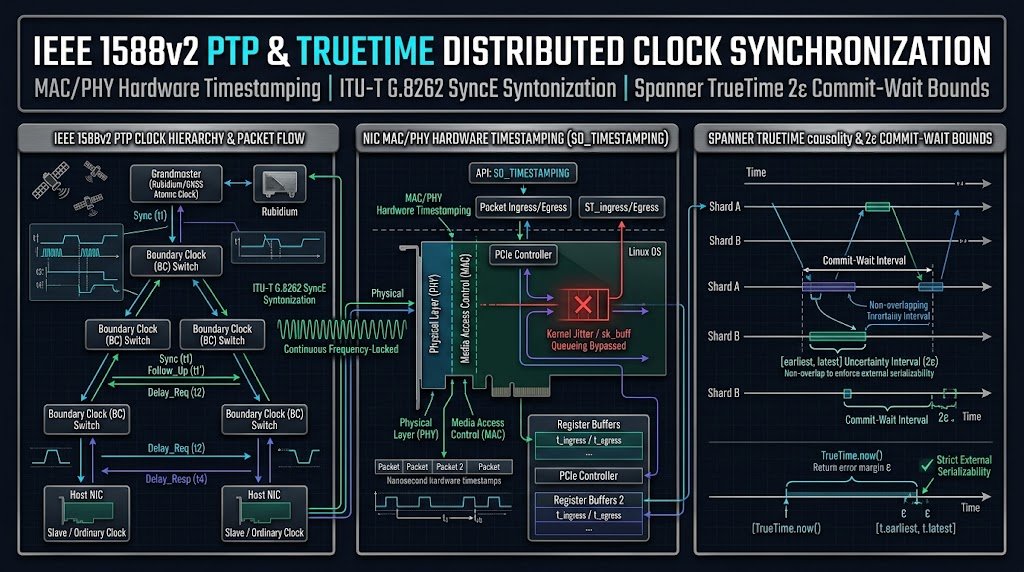
In globally distributed transactional databases and ultra-low-latency quantitative execution venues, wall-clock time is not merely a logging convenience—it is a foundational correctness and regulatory primitive. Standard Network Time Protocol (NTP) daemons operating over user-space UDP sockets suffer from multi-millisecond operating system scheduling jitter, asymmetric routing queuing delays, and quartz crystal oscillator thermal drift ($\pm 20\text{ to }100\text{ ppm}$). Achieving deterministic external consistency (linearizability) in distributed commit protocols without cross-continental quorum round-trips requires driving inter-node clock uncertainty ($\varepsilon$) down from milliseconds to tens of nanoseconds. Modern data-center infrastructure accomplishes this by combining IEEE 1588-2019 (PTPv2) Precision Time Protocol hardware timestamping at the Ethernet Physical Coding Sublayer (PCS), ITU-T G.8262 Synchronous Ethernet (SyncE) frequency syntonization, and TrueTime-style $[t - \varepsilon, \, t + \varepsilon]$ commit-wait barriers.
1. Eliminating OS Stack Jitter: IEEE 1588v2 Two-Step Exchange & PHY Timestamping
The primary error source in software-based time synchronization is non-deterministic variance inside the host operating system's network stack: interrupt coalescing, NAPI poll scheduling, sk_buff allocation, and socket buffer traversal introduce tens of microseconds of asymmetric delay between the moment an Ethernet frame crosses the physical wire and the moment a user-space daemon reads the system clock (CLOCK_REALTIME).
The IEEE 1588v2 Precision Time Protocol eliminates OS stack variance entirely by moving timestamp capture out of software and embedding a dedicated PTP Hardware Clock (PHC) directly inside the Network Interface Card (NIC) MAC or Physical Layer (PHY) transceiver silicon. Using a four-timestamp bidirectional message exchange between a Grandmaster Clock (GM) (disciplined via dual-band GNSS receivers and Rubidium/Oven-Controlled Crystal Oscillators, OCXO) and an Ordinary Slave Clock, PTP solves simultaneously for mean propagation path delay ($d$) and master-to-slave clock offset ($\theta$):
- `Sync` & `Follow_Up` (Master $\to$ Slave): The Grandmaster transmits a
Syncpacket at time $t_1$, capturing the exact nanosecond the Start-of-Frame Delimiter (SFD) crosses the physical MAC/PHY interface. In a two-step clock architecture, the hardware egress timestamp $t_1$ is transmitted inside a subsequentFollow_Upmessage, while the slave NIC captures the exact hardware ingress timestamp $t_2$ upon arrival. - `Delay_Req` & `Delay_Resp` (Slave $\to$ Master): The slave transmits a
Delay_Reqframe, recording its hardware egress timestamp $t_3$. The Grandmaster captures the hardware ingress timestamp $t_4$ and returns $t_4$ to the slave inside aDelay_Resppacket.
$$d = \frac{(t_2 - t_1) + (t_4 - t_3)}{2}, \qquad \theta = \frac{(t_2 - t_1) - (t_4 - t_3)}{2} + \frac{d_{\text{ms}} - d_{\text{sm}}}{2}$$ Where $(t_2 - t_1) = d_{\text{ms}} + \theta$ and $(t_4 - t_3) = d_{\text{sm}} - \theta$. Any uncompensated physical fiber or switch queuing asymmetry ($d_{\text{ms}} \neq d_{\text{sm}}$) introduces a bias equal to half the path asymmetry.
$$\text{CF}_{\text{egress}} = \text{CF}_{\text{ingress}} + \left( t_{\text{switch\_egress}}^{\text{PHY}} - t_{\text{switch\_ingress}}^{\text{PHY}} \right) + d_{\text{peer\_link}}$$ End-to-End (E2E) and Peer-to-Peer (P2P) Transparent Switches measure exact packet residence time across switch ASIC buffers at nanosecond resolution and accumulate it in the 64-bit PTP
correctionField.
2. Physical Layer Frequency Syntonization: Synchronous Ethernet (SyncE) & White Rabbit
While IEEE 1588v2 aligns phase and time-of-day (ToD) via packet exchanges, Free-Running Quartz Oscillators on commodity server NICs still drift in frequency between successive PTP Sync intervals due to ambient thermal gradients across the server chassis. To lock oscillator frequency directly at the physical layer, enterprise telecom and financial fabrics pair PTPv2 with ITU-T G.8262 Synchronous Ethernet (SyncE).
In a SyncE-enabled switch and NIC topology, the receiver's Clock and Data Recovery (CDR) circuit extracts the exact $25.78125\text{ GHz}$ (or $53.125\text{ Gbd}$ PAM4) line-rate symbol clock directly from the incoming physical serial bit stream, filters phase noise through a narrow-bandwidth Digital Phase-Locked Loop (DPLL), and uses that recovered clock to drive its own egress SerDes transmitter. This achieves continuous hardware syntonization (zero frequency drift across the entire rack), allowing the upper-layer PTPv2 proportional-integral (PI) servo loop (linuxptp / ptp4l) to correct pure phase offset with sub-nanosecond stability.
3. Comparative Synchronization Architecture: NTP vs. PTPv2 vs. White Rabbit
Infrastructure architects evaluate distributed time-synchronization stacks across five precision, hardware-support, and failure-tolerance metrics:
| Synchronization Metric | NTPv4 (`chronyd` Software) | IEEE 1588v2 PTP (`ptp4l` HW) | IEEE 1588-2019 High-Accuracy (White Rabbit) |
|---|---|---|---|
| Timestamp Capture Point | Kernel interrupt / User-space socket | NIC MAC / PHY (`SO_TIMESTAMPING`) | PHY SerDes + Digital Dual-Mixer Time Difference (DDMTD) |
| Typical Uncertainty Bound ($\varepsilon$) | $500\,\mu\text{s} \text{ to } 10.0\text{ ms}$ | $25\text{ ns} \text{ to } 250\text{ ns}$ (with TC/BC switches) | $< 100\text{ picoseconds}$ ($0.1\text{ ns}$) |
| Frequency Syntonization | Software `adjtimex()` tick slewing | PHC PI Servo + Optional ITU-T SyncE | Mandatory L1 SyncE + Carrier Phase Tracking |
| Switch Fabric Requirement | Commodity L3 switches (Subject to ECMP jitter) | PTP Boundary (BC) or Transparent Clocks (TC) | White Rabbit Calibrated Optical Fiber & Switches |
| Regulatory / DB Target | General enterprise application logs | MiFID II RTS 25 ($100\,\mu\text{s}$), Distributed SQL (TrueTime) | CERN Particle Accelerators, Quantum Optical Grids |
4. Linux Kernel PHC Architecture (`ptp4l` & `phc2sys`) and TrueTime Commit-Wait Semantics
Inside the Linux kernel, each PTP-capable network adapter exposes a character device node at /dev/ptpN managed by the PTP Hardware Clock (PHC) subsystem. Two cooperating daemons bridge the NIC hardware clock to user-space database engines:
ptp4l(Network-to-NIC Synchronization): Exchanges IEEE 1588v2 hardware-timestamped frames over the network using theSO_TIMESTAMPINGsocket option (with flagsSOF_TIMESTAMPING_TX_HARDWAREandSOF_TIMESTAMPING_RX_HARDWARE) and disciplines the NIC's on-board/dev/ptp0register viaclock_adjtime().phc2sys(NIC-to-System-Clock Synchronization): Uses the PCIe Precision Time Measurement (PTM) capability or thePTP_SYS_OFFSET_EXTENDEDioctl to measure the exact nanosecond delta between the NIC's/dev/ptp0register and the CPU's Time Stamp Counter (TSC/CLOCK_REALTIME), eliminating PCIe bus traversal jitter.
In globally distributed NewSQL databases modeled on Google Spanner's TrueTime API (such as CockroachDB and YugabyteDB), the clock synchronization subsystem does not return a single scalar timestamp; instead, calling TT.now() returns a bounded confidence interval $[t_{\text{earliest}}, \, t_{\text{latest}}]$ where the instantaneous absolute time $t_{\text{abs}}$ is guaranteed to lie within radius $\varepsilon = (t_{\text{latest}} - t_{\text{earliest}}) / 2$. To guarantee that if transaction $T_2$ begins in real time after transaction $T_1$ commits ($t_{\text{abs}}(T_1) < t_{\text{abs}}(T_2)$), its assigned MVCC commit timestamp strictly reflects causal order ($s_1 < s_2$), the coordinator node enforces the Commit-Wait Rule: assigning commit timestamp $s_1 = \text{TT.now().latest}$ and holding the transaction commit barrier until $\text{TT.now().earliest} > s_1$—introducing a deterministic worst-case commit stall of exactly $2\varepsilon$.
$$\varepsilon(t) = \varepsilon_{\text{base}} + \rho_{\text{drift}} \cdot \left( t - t_{\text{last\_sync}} \right), \qquad T_{\text{commit\_wait}} = 2\,\varepsilon(t)$$ Where $\varepsilon_{\text{base}}$ is the PTP/GNSS base synchronization uncertainty and $\rho_{\text{drift}}$ is the worst-case local oscillator frequency drift rate (e.g., $200\,\mu\text{s/sec}$ for quartz vs. $1\,\mu\text{s/sec}$ for Rubidium/OCXO). Reducing $\varepsilon$ from $7\text{ ms}$ (NTP) to $50\text{ ns}$ (PTPv2) eliminates multi-millisecond write-transaction commit stalls.
Primary Hardware Timing & Distributed Systems References
- 1. IEEE Standards Association: IEEE Std 1588™-2019 — IEEE Standard for a Precision Clock Synchronization Protocol for Networked Measurement and Control Systems (PTPv2.1).
- 2. USENIX Symposium on Operating Systems Design and Implementation (OSDI): Spanner: Google's Globally-Distributed Database — TrueTime API & External Consistency Proofs (Corbett et al.).
- 3. Linux Kernel Organization Documentation: Linux Kernel Timestamping (`SO_TIMESTAMPING`) & PTP Hardware Clock (`drivers/ptp/`) Subsystem Architecture.
- 4. International Telecommunication Union (ITU-T): ITU-T Recommendation G.8262 — Timing Characteristics of Synchronous Ethernet (SyncE) Equipment Slave Clocks.
Related Distributed Systems & Network Architecture Research
TrendSpike Editorial Team
Staff Research & Technical AnalysisIndependent research covering distributed cloud systems, modern enterprise software engineering, and macro-financial policy. Our technical and financial analyses reference primary documentation, official regulatory filings, and benchmark architectures.