IRC Section 409A Deferred Compensation, Section 83(b) Elections, and Section 280G Golden Parachute Mechanics: Valuation Safe Harbors, Early Exercise Tax Math, and 2.99x Base Amount Cliffs
An institutional executive compensation and M&A tax analysis of Internal Revenue Code Sections 409A, 83(b), 422, 280G, and 4999, detailing private-company common stock valuation safe harbors, the 20% nonqualified deferred compensation penalty tax, 30-day restricted stock elections, and the 3.0x change-in-control golden parachute excise cliff.
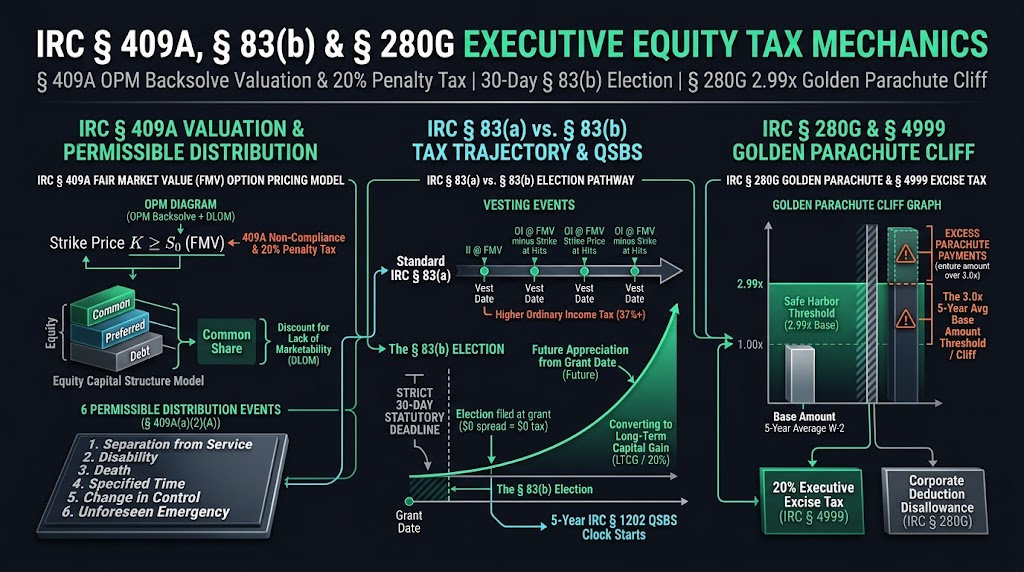
In venture-backed technology companies, private equity portfolio buyouts, and public corporation M&A transactions, structuring founder equity, employee stock options, and change-in-control retention packages requires navigating three unforgiving provisions of the U.S. Internal Revenue Code: IRC Section 409A (Nonqualified Deferred Compensation), IRC Section 83 (Property Transferred in Connection with Performance of Services), and IRC Sections 280G and 4999 (Golden Parachute Change-in-Control Payments). Unlike general corporate tax provisions that adjust effective rates marginally, violating Section 409A or crossing the Section 280G $3.0\times$ cliff triggers punitive $20\%$ federal excise and penalty taxes (plus premium interest surcharges and state equivalents such as California Revenue & Taxation Code § 17501) coupled with permanent corporate deduction disallowances. Institutional tax counsel, compensation committees, and M&A deal teams rely on mathematical safe harbors—including Treas. Reg. § 1.409A-1(b)(5)(iv)(B) independent valuation presumptions, strict 30-day Section 83(b) early exercise filings, and Section 280G(b)(5) private-company shareholder cleansing votes—to preserve capital gains treatment and deal economics.
1. IRC Section 409A: Nonqualified Deferred Compensation, Strike Price Parity & The 20% Penalty
Enacted under the American Jobs Creation Act of 2004, IRC Section 409A sweeps broadly across any contractual arrangement where a service provider (employee, director, or certain independent contractors) obtains a legally binding right in one taxable year to compensation that is payable in a subsequent taxable year—unless the payment qualifies for the Short-Term Deferral Exception (Treas. Reg. § 1.409A-1(b)(4)) by being paid no later than the $15^{\text{th}}$ day of the third month ($2.5\text{ months}$) following the end of the fiscal year in which the right is no longer subject to a Substantial Risk of Forfeiture (SROF).
If an arrangement falls inside Section 409A, payment acceleration is strictly prohibited, and distributions may occur exclusively upon one of six statutory triggering events under IRC § 409A(a)(2)(A): (1) Separation from Service (subject to a mandatory 6-month delay for "Specified Employees" of public companies under § 409A(a)(2)(B)(i)), (2) Disability, (3) Death, (4) a Fixed Time or Schedule specified at initial deferral, (5) a qualified Section 409A Change in Control event, or (6) an Unforeseeable Emergency. For compensatory stock options (Nonqualified Stock Options, NSOs) and Stock Appreciation Rights (SARs) to remain completely exempt from Section 409A under Treas. Reg. § 1.409A-1(b)(5)(i)(A), the exercise strike price ($K$) on the grant date must never be less than the Fair Market Value ($S_0$) of the underlying common stock ($K \ge S_0$). Private companies establish an evidentiary presumption of reasonableness (shifting the burden of proof to the IRS) by obtaining an independent 409A valuation report within the preceding $12\text{ months}$ utilizing the AICPA Option Pricing Method (OPM Backsolve) or Probability-Weighted Expected Return Method (PWERM) combined with a Discount for Lack of Marketability (DLOM). Granting discounted "in-the-money" options ($K < S_0$) causes the entire option spread to become taxable as ordinary income immediately upon vesting (even if unexercised), plus an immediate $20\%$ federal penalty tax under IRC § 409A(a)(1)(B)(i)(II) and a heightened underpayment interest rate ($1\%$ above the federal underpayment rate from the year of vesting).
$$T_{83(a)} = \sum_{k=1}^{M} \Delta N_k \left(S_{t_k} - K\right) \tau_{\text{Ord}} + N_{\text{Total}}\left(S_{\text{Exit}} - \bar{S}_{\text{Vest}}\right)\tau_{\text{LTCG}}, \qquad T_{83(b)} = N_{\text{Total}}\left(S_0 - K\right)\tau_{\text{Ord}} + N_{\text{Total}}\left(S_{\text{Exit}} - S_0\right)\tau_{\text{LTCG}}$$ Where $S_0$ is grant-date Fair Market Value, $K$ is purchase/exercise price, $S_{t_k}$ is FMV at each vesting tranche $t_k$, and $S_{\text{Exit}}$ is final M&A/IPO sale price. When $S_0 = K$ at grant, filing a valid Section 83(b) election within $30\text{ calendar days}$ yields zero upfront ordinary income ($S_0 - K = \$0$) and converts $100\%$ of future appreciation ($S_{\text{Exit}} - S_0$) from $\tau_{\text{Ord}} = 37\%$ (+ payroll tax) to $\tau_{\text{LTCG}} = 20\%$ (or $0\%$ if eligible under IRC § 1202 QSBS).
$$\text{Cliff Threshold} = 3.0 \times B_{\text{5yr\_Avg}}, \qquad \text{If } \sum P_{\text{Parachute}} \ge 3.0\,B_{\text{5yr\_Avg}} \implies \begin{cases} T_{\text{Excise (§4999)}} = 0.20 \times \left(\sum P_{\text{Parachute}} - \mathbf{1.0}\,B_{\text{5yr\_Avg}}\right) \\ \text{Denied Corporate Deduction (§280G)} = \sum P_{\text{Parachute}} - \mathbf{1.0}\,B_{\text{5yr\_Avg}} \end{cases}$$ Where $B_{\text{5yr\_Avg}}$ is the executive's "Base Amount" (average annual Box 1 W-2 taxable compensation over the $5\text{ calendar years}$ preceding the year of the change in control). Crossing $3.0 \times B_{\text{5yr\_Avg}}$ by even $\$1.00$ penalizes the entire excess above $1.0 \times B_{\text{5yr\_Avg}}$—not merely the excess above $3.0\times$.
2. IRC Section 83(b) Elections & Equity Compensation Instrument Comparison
Under IRC Section 83(a), when restricted stock (or unvested stock acquired via an "early-exercise" stock option) is transferred to an executive subject to a time-based vesting schedule (a Substantial Risk of Forfeiture), the IRS ignores the initial transfer and taxes the spread between Fair Market Value and price paid ($S_{t_k} - K$) as W-2 ordinary compensation income at each future vesting date $t_k$. By contrast, filing an IRC Section 83(b) Election (including via the modernized IRS Form 15620) within the statutory, non-extendable 30-calendar-day deadline from the date of transfer instructs the IRS to close the ordinary compensation event on Day 1 based on the initial spread ($S_0 - K$), starting both the 1-year long-term capital gains clock and the 5-year IRC Section 1202 Qualified Small Business Stock (QSBS) holding period immediately.
Corporate tax advisors evaluate five primary executive equity instruments across grant, vesting, exercise, and M&A exit phases:
| Equity Instrument | Statutory Citation | IRC § 83(b) Eligible? | Vesting / Exercise Tax Event | Corporate Tax Deduction (§ 83(h)) |
|---|---|---|---|---|
| Restricted Stock Award (RSA) | IRC § 83(a) & § 83(b) | Yes (Must file within 30 calendar days of transfer) | With § 83(b): Ordinary income at Grant ($S_0 - K$); $0$ at vesting | Matches executive's ordinary income inclusion (subject to § 162(m)) |
| Incentive Stock Option (ISO) | IRC § 421 & § 422 ($100\text{k}$ annual vest cap) | Special AMT § 83(b) only if early-exercised while unvested | Zero regular tax at exercise; spread ($S_{\text{Ex}} - K$) is an IRC § 56(b)(3) AMT preference item | Zero ($0) deduction if 2-year grant / 1-year exercise holding periods met |
| Nonqualified Stock Option (NSO) | IRC § 83(e)(3) & § 409A ($K \ge S_0$) | Yes, only upon early exercise of unvested option into restricted stock | Spread ($S_{\text{Ex}} - K$) taxed as W-2 ordinary + FICA income upon exercise | Full corporate deduction equal to ordinary spread upon exercise |
| Restricted Stock Unit (RSU) | IRC § 409A & § 451 (Unfunded promise) | No (Not actual "property" under § 83 until shares settle; § 83(i) rare) | Full share value taxed as W-2 ordinary income upon share delivery/settlement | Full deduction upon settlement (capped by IRC § 162(m) $1\text{M}$ public rule) |
| Partnership Profits Interest | Rev. Proc. 93-27 & Rev. Proc. 2001-43 (LLC Units) | Protective § 83(b) routinely filed ($0$ liquidation value at grant) | Zero tax at grant or vesting if hurdle $\ge$ current entity liquidation value | Pass-through capital gain allocation (subject to 3-year IRC § 1061 carry rule) |
3. IRC Section 280G & Section 4999 Golden Parachute Mechanics in M&A Transactions
When a corporation undergoes a Change in Ownership or Control (typically an acquisition of $> 50\%$ of total voting power or fair market value, or $\ge 1/3$ of gross asset value), IRC Section 280G and IRC Section 4999 test all compensatory payments contingent on the transaction—including transaction bonuses, severance payments, and the parachute portion of accelerated unvested stock options and RSUs—payable to "Disqualified Individuals" (officers, Top-1% compensated employees, and $\ge 1\%$ shareholders).
As quantified in Equation 2, Section 280G operates as a severe cliff threshold rather than a progressive bracket:
- The $2.99\times$ Safe Harbor vs. The $3.00\times$ Cliff: Each Disqualified Individual's Base Amount ($B_{\text{5yr\_Avg}}$) is calculated as their average annual Box 1 W-2 taxable compensation from the target corporation over the five calendar years preceding the year of closing (the "Base Period"). So long as the aggregate present value of all contingent parachute payments remains at or below $2.9999\times$ the Base Amount, zero Section 280G penalty applies. However, if total parachute payments reach or exceed $3.00\times$ the Base Amount, the entire excess above $1.00\times$ the Base Amount (defined as the "Excess Parachute Payment") becomes permanently non-deductible to the acquiring/target corporation under IRC § 280G(a) and triggers a non-deductible $20\%$ personal excise tax on the executive under IRC § 4999(a).
- The Treas. Reg. § 1.280G-1 Q&A-24(c) Acceleration Valuation Formula: When an M&A deal accelerates the vesting of time-based equity awards (options or RSUs) that would otherwise have vested solely through continued employment, Section 280G does not treat $100\%$ of the accelerated payout as a parachute payment. Instead, under Q&A-24(c), the parachute value equals the sum of two smaller components: (1) the Value of the Acceleration of Payment (the spread discounted from the original future vesting date back to the closing date using $120\%$ of the Applicable Federal Rate under IRC § 1274(d)), plus (2) the Value of the Lapse of the Obligation to Continue Performing Services, locked at exactly $1\%$ of the full accelerated award value per full calendar month of accelerated vesting.
- Mitigation Mechanisms — "Best-Net Cutback" Clauses & The IRC § 280G(b)(5)(B) Private-Company 75% Shareholder Cleansing Vote: Public company executive agreements typically incorporate a "Best-Net Cutback" provision, which automatically reduces the executive's parachute payout to $2.99\times$ Base Amount if (and only if) the reduction leaves the executive with a higher net after-tax dollar amount than paying the $20\%$ excise tax across the $1.0\times\text{ to }3.0\times$ band. Conversely, private C-corporations without publicly traded stock can completely exempt excess parachute payments from Section 280G by executing a formal Section 280G(b)(5)(B) Shareholder Cleansing Vote: the executive first signs a legally binding waiver relinquishing the excess above $2.99\times$, the company provides comprehensive disclosure of all Disqualified Individuals' parachute calculations to all shareholders, and more than $75\%$ of the disinterested voting power approves restoring the waived payments prior to closing.
Primary Statutory & Executive Compensation Tax References
- 1. United States Code & Treasury Regulations (26 CFR): IRC § 409A & Treas. Reg. § 1.409A-1 through -6 — Nonqualified Deferred Compensation, Stock Rights Valuation Safe Harbors, and Short-Term Deferral Exceptions.
- 2. United States Code & IRS Filing Guidance: IRC § 83(a) & § 83(b) (Property Transferred in Connection With Performance of Services), IRS Form 15620, and IRC § 422 (Incentive Stock Options).
- 3. United States Code & Treasury Regulations: IRC § 280G & IRC § 4999 (Golden Parachute Payments), Treas. Reg. § 1.280G-1 Q&A-24(c) Vesting Acceleration Valuation, and Q&A-7 Private-Company 75% Cleansing Votes.
Related Corporate M&A & Executive Equity Tax Research
TrendSpike Editorial Team
Staff Research & Technical AnalysisIndependent research covering distributed cloud systems, modern enterprise software engineering, and macro-financial policy. Our technical and financial analyses reference primary documentation, official regulatory filings, and benchmark architectures.