Linux Kernel EEVDF and sched_ext (SCX) CPU Scheduler Architecture: Virtual Deadline Lag Mechanics, eBPF Dispatch Queues (DSQ), and L3 Cache-Aware Core Scheduling
An institutional systems engineering analysis of the Linux kernel CPU scheduling subsystem, detailing the transition from CFS to Earliest Eligible Virtual Deadline First (EEVDF), augmented red-black runqueue trees, the sched_ext (SCX) eBPF extensible scheduler class, and SMT Core Scheduling security isolation.
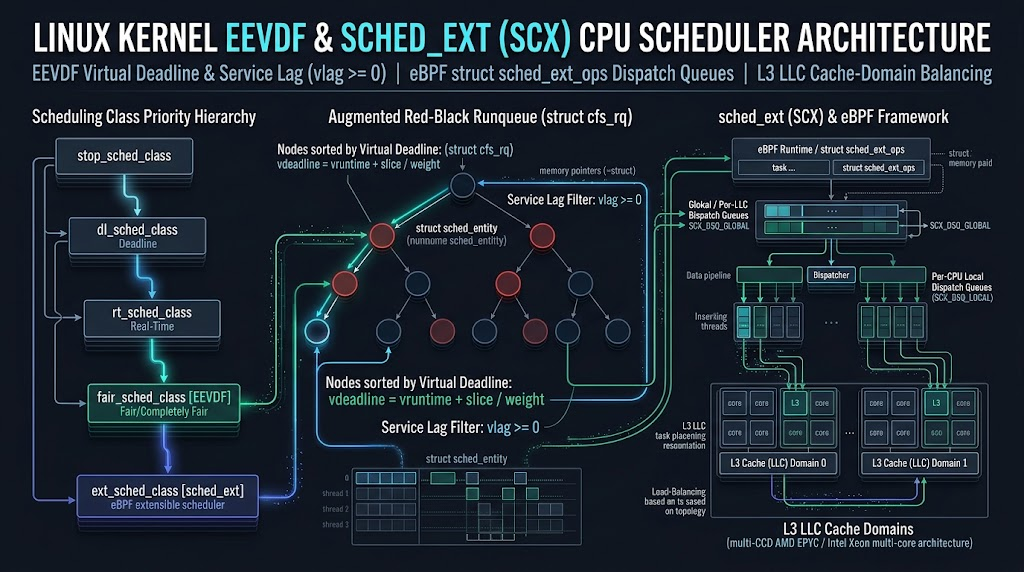
In multi-socket cloud hypervisors, latency-critical microservices, and high-density AMD EPYC and Intel Xeon servers equipped with chiplet-partitioned Last-Level Caches (LLCs), CPU scheduling decisions directly govern instruction cache locality and tail latency ($p_{99.9}$). For over sixteen years, the Linux kernel relied on the Completely Fair Scheduler (CFS) to multiplex runnable tasks across physical cores; however, CFS required brittle heuristic "sleeper fairness" nudges and lacked an intrinsic notion of latency slice requirements, causing latency-sensitive interactive threads to starve behind batch compute workloads of identical nice weight. Modern Linux kernels ($6.6+$ and $6.12+$) fundamentally re-architect CPU multiplexing around two landmark subsystems: the Earliest Eligible Virtual Deadline First (EEVDF) algorithm inside fair_sched_class, and the Extensible Scheduler Class (sched_ext / SCX), which enables production data centers to load verified, crash-safe custom CPU scheduling policies dynamically via eBPF struct_ops without rebooting the host kernel.
1. From CFS to EEVDF: Service Lag (`vlag`), Eligibility & Virtual Deadlines (`vdeadline`)
Under the legacy Completely Fair Scheduler (CFS), each runnable task (represented by struct sched_entity embedded inside struct task_struct) accumulated weighted virtual runtime (vruntime), and the per-CPU runqueue (struct cfs_rq) simply selected the leftmost node in a red-black tree possessing the minimum vruntime. Because CFS tracked only how much CPU time a task had consumed (`vruntime`) without tracking how fast the task needed its next slice, latency-sensitive tasks (such as RPC handlers or audio/video compositors) requesting short $0.5\text{ ms}$ bursts were forced to wait behind CPU-bound batch compilation threads sharing the same `vruntime` horizon.
Introduced by Stoica and Abdel-Wahab and mainlined into the Linux Kernel EEVDF Scheduler (`kernel/sched/fair.c`), EEVDF eliminates heuristic CFS latency tweaks by assigning every runnable entity both a weight $w_i$ (derived from its `nice` value via sched_prio_to_weight[], where `nice 0` equals $w_0 = 1024$) and a requested time slice ($r_i$ / `slice`):
- Service Lag (
vlag) & The Eligibility Invariant: EEVDF tracks the exact difference between the theoretical fair share of CPU service a task should have received in an idealized fluid-model system and the actual service $s_i$ it has received so far. A task's Lag ($\text{lag}_i$) is positive or zero ($\text{lag}_i \ge 0$) if and only if the system owes the task CPU time—making the task Eligible ($E$) for immediate execution. Conversely, a task with negative lag ($\text{lag}_i < 0$) has temporarily consumed more than its proportional share and is strictly ineligible until other tasks catch up. - Virtual Eligibility Time ($V_{e,i}$) & Virtual Deadline ($V_{d,i}$): Rather than recomputing floating-point lag across every runnable thread on each tick, the kernel maintains the runqueue's weighted average virtual runtime ($V$) and computes each entity's virtual eligibility point $V_{e,i}$ and Virtual Deadline (`vdeadline`, $V_{d,i}$) as a function of its requested slice length $r_i$ and weight $w_i$.
- Augmented Red-Black Tree Selection ($O(\log N)$): All runnable
sched_entitystructures in a CPU'scfs_rqare indexed in an augmented red-black tree sorted by ascending Virtual Deadline ($V_{d,i}$), where each internal tree node caches the minimum virtual eligibility time ($\min V_{e}$) of its entire subtree. Duringpick_eevdf(), the scheduler traverses the tree in $\mathcal{O}(\log N)$ time to pick the runnable entity with the earliest virtual deadline ($V_{d,i}$) among all eligible tasks ($V_{e,i} \le V$). Consequently, latency-critical tasks requesting short slices ($r_i$) receive an early virtual deadline and preempt bulk throughput tasks immediately without violating long-term proportional fairness.
$$\text{lag}_i(t) = w_i \cdot \Big(V(t) - v_i(t)\Big), \qquad \text{Eligible}(i) \iff \text{lag}_i(t) \ge 0 \iff V_{e,i} \le V(t), \qquad V_{d,i} = V_{e,i} + \frac{r_i}{w_i}$$ Where $V(t)$ is the runqueue-wide weighted average virtual time, $v_i(t)$ is task $i$'s accumulated virtual runtime, $w_i$ is task weight (`NICE_0_LOAD = 1024`), and $r_i$ is the task's requested time slice (`sysctl_sched_base_slice`). When a sleeping task wakes or a running task is preempted, its scaled lag `vlag` is preserved relative to the moving runqueue average $V(t)$.
$$U_{\text{PELT}} = u_0 + u_1\,y + u_2\,y^2 + \dots + u_n\,y^n = \sum_{k=0}^{\infty} u_k\,y^k, \qquad \text{where } y^{32} = 0.5 \implies y \approx 0.97857206$$ Where $u_k \in [0, 1024]$ is the time a task spent runnable during millisecond period $k$ (`1024` $\approx 1\text{ ms}$). PELT feeds historical CPU utilization directly into `schedutil` DVFS frequency scaling and cross-LLC load balancing (`sched_balance_rq()`).
2. The Linux Scheduler Class Hierarchy & `sched_ext` (`SCX`) eBPF Architecture
When a CPU core invokes __schedule() to context-switch to the next thread, the core kernel iterates sequentially through a linked hierarchy of scheduling classes (struct sched_class) ordered strictly by priority: stop_sched_class (highest-priority per-CPU migration/RCU stoppers) $\to$ dl_sched_class (SCHED_DEADLINE Earliest Deadline First with CBS bandwidth throttling) $\to$ rt_sched_class (POSIX real-time SCHED_FIFO / SCHED_RR) $\to$ fair_sched_class (EEVDF for SCHED_NORMAL / SCHED_BATCH) $\to$ ext_sched_class (the eBPF Extensible Scheduler Class) $\to$ idle_sched_class.
Mainlined in Linux 6.12, sched_ext (`CONFIG_SCHED_CLASS_EXT`) allows infrastructure engineers to implement complete, domain-specific scheduling algorithms in C or Rust compiled to eBPF bytecode via the struct sched_ext_ops interface:
- Dispatch Queues (DSQs — Local, Global, and Custom Per-LLC): To decouple eBPF policy logic from low-level kernel runqueue locking,
sched_extintroduces the Dispatch Queue (struct scx_dispatch_q, DSQ) primitive. Every physical CPU possesses a built-in local DSQ (SCX_DSQ_LOCAL), and the system exposes a default global DSQ (SCX_DSQ_GLOBAL). An eBPF scheduler can dynamically allocate custom DSQs viascx_bpf_create_dsq()—for example, creating one dedicated DSQ per AMD EPYC Core Complex Die (CCD / L3 cache domain) or per NUMA node—and insert tasks using FIFO ordering (scx_bpf_dsq_insert()) or virtual-time priority ordering (scx_bpf_dsq_insert_vtime()). - The
sched_ext_opsLifecycle Hooks: When a task wakes up, the kernel invokesops.select_cpu(p, prev_cpu, wake_flags), allowing the eBPF program to inspect idle CPU bitmasks (scx_bpf_get_idle_cpumask()) and immediately push the waking thread directly into an idle sibling core'sSCX_DSQ_LOCAL—bypassing global queue lock contention entirely. If no idle core is available,ops.enqueue(p, enq_flags)places the task into a custom DSQ, and when a CPU exhausts its local work,ops.dispatch(cpu, prev)pulls a batch of tasks from custom DSQs viascx_bpf_dsq_move_to_local(). - Hardware Watchdog & Zero-Downtime Fallback Safety: Unlike out-of-tree kernel patches that trigger a fatal kernel panic (`BUG_ON()`) if a scheduler contains a livelock or starvation bug,
sched_extenforces a kernel-level watchdog timer (default $30\text{ seconds}$). If an eBPF scheduler fails to schedule a runnable task before the watchdog expires—or if the eBPF verifier/runtime detects an invalid DSQ operation—the kernel automatically aborts the eBPF scheduler, evacuates all tasks seamlessly back into the standard EEVDFfair_sched_classin microseconds, and logs the exact exit backtrace to user space without dropping a single production request.
3. Comparative Architecture of Linux Scheduling Classes & Production `scx` Policies
Platform engineering teams evaluate built-in Linux scheduling classes alongside production `sched_ext` (`scx`) schedulers across latency guarantees, cache-domain awareness, and isolation capabilities:
| Scheduler / SCX Policy | Core Queueing / Selection Algorithm | LLC / NUMA Topology Awareness | Starvation / Safety Mechanism | Primary Data-Center / Edge Workload |
|---|---|---|---|---|
fair_sched_class (EEVDF) |
Per-CPU Augmented RB-Tree (`vdeadline` + `vlag >= 0`) | Periodic PELT load balancing across `sched_domain` hierarchy | Mathematical fluid-model lag bounds | Default general-purpose Linux server & desktop workloads |
dl_sched_class (SCHED_DEADLINE) |
Global/Clustered Earliest Deadline First (EDF) + CBS | Root-domain admission control ($\sum Q_i / P_i \le M$) | Constant Bandwidth Server (CBS) hard throttling | Hard real-time robotics, 5G vRAN PHY, & industrial control |
scx_lavd (Latency-Critical Virtual Deadline) |
eBPF runtime latency-criticality scoring (`wait_freq * wake_freq`) | Core compaction onto active CCXs during low load; P/E-core aware | `sched_ext` 30s watchdog + auto-fallback to EEVDF | Interactive cloud gaming, frame-paced rendering, & RPC pipelines |
scx_bpfland / scx_rusty |
Multi-domain per-LLC vtime DSQs + interactive voluntary-nvcsw boost | Explicit per-CCD / L3 cache-domain DSQ partitioning | `sched_ext` kernel watchdog + BPF verifier bounds | Multi-chiplet AMD EPYC / Ryzen clusters & web-tier microservices |
scx_layered (Meta Fleet Scheduler) |
Hierarchical cgroup/thread classification into custom CPU layers | Dedicated LLC pinning per service tier with work-conserving spillover | Guaranteed minimum CPU layer quotas + `sched_ext` watchdog | Hyperscale co-located inference/web + background batch containers |
4. SMT Core Scheduling (`CONFIG_SCHED_CORE`) & Cross-Hyperthread Side-Channel Isolation
On Simultaneous Multithreading (SMT / Intel Hyper-Threading) processors, two logical CPU sibling threads share a single physical execution pipeline, L1 Data/Instruction caches, L2 cache, and microarchitectural store buffers. While SMT increases aggregate throughput by $15\text{--}30\%$, co-scheduling threads belonging to different multi-tenant security domains (or mixing host hypervisor kernel threads with untrusted KVM guest vCPU threads) on sibling hyperthreads exposes hardware speculative-execution side channels (including L1 Terminal Fault `L1TF`, Microarchitectural Data Sampling `MDS`, and Cross-HT cache timing attacks)—as well as noisy-neighbor ALU/AVX-512 execution port contention.
Rather than disabling SMT globally via nosmt and sacrificing up to $25\%$ of data-center compute capacity, the Linux kernel implements Core Scheduling (`CONFIG_SCHED_CORE`, controlled via `prctl(PR_SCHED_CORE)`). Core Scheduling assigns a cryptographic 64-bit Core Cookie (core_cookie) to trusted process groups or container cgroups and synchronizes task selection across all SMT siblings of a physical core via a shared spinlock and core-wide red-black tree (`rq->core_tree`). When the highest-priority runnable thread across a physical core's SMT siblings is selected, the scheduler inspects sibling runqueues: if a sibling hyperthread only has runnable tasks with a mismatched `core_cookie`, that sibling hyperthread is forced into a synthetic idle state ("forced idle") rather than violating the isolation boundary—preserving full SMT acceleration for threads within the same trust domain while guaranteeing hardware-level isolation between tenants.
Primary Linux Kernel Scheduler & Architecture References
- 1. Linux Kernel Core Scheduler Documentation: EEVDF Scheduler (`kernel/sched/fair.c`) — Earliest Eligible Virtual Deadline First, Service Lag Invariants, and Augmented Red-Black Runqueues.
- 2. Linux Kernel Extensible Scheduler Documentation: `sched_ext` (`CONFIG_SCHED_CLASS_EXT`) — eBPF `struct sched_ext_ops`, Dispatch Queues (`DSQ`), and Watchdog Safety Architecture.
- 3. Linux Kernel Hardware Vulnerability & SMT Isolation Guide: Core Scheduling (`PR_SCHED_CORE`) — SMT Sibling Cookie Matching, Forced-Idle Accounting, and L1/MDS Side-Channel Mitigation.
Related Linux Kernel & Systems Architecture Research
- → Linux Kernel Read-Copy-Update (RCU) Synchronization Architecture: Lockless Reader Critical Sections, Hierarchical Tree RCU Grace Periods, and Callback Offloading
- → Linux Kernel Memory Management Architecture: SLUB Allocator Per-CPU Freelist Fastpaths, 5-Level Page Table Walks, and Transparent Huge Page (THP) TLB Coherency
TrendSpike Editorial Team
Staff Research & Technical AnalysisIndependent research covering distributed cloud systems, modern enterprise software engineering, and macro-financial policy. Our technical and financial analyses reference primary documentation, official regulatory filings, and benchmark architectures.